
Everywhere in Bolivia is far away from everywhere else, especially if you have to get there by public transportation, much of which is private and unregulated. Big comfortable busses make night runs between major cities, but to get to anywhere in between one must rely upon shared taxis known as “trufis”.
Trufis range from derelict sedans with bad brakes to overstuffed minivans with tiny seats made for school children. All are overcrowded, uncomfortable, and dangerous. None run on schedule. The vehicle leaves when it is crammed full, and not before. Chickens are optional.
Try to imagine a lengthy journey over bad mountain roads in a minivan packed with twice as many people as there are seats, all during a Covid epidemic. Did you think it would be easy to travel back in time to the land of dinosaurs? I would advise you to buckle up, but there aren’t any seatbelts.
………………………………………….
In late May of 2022, after returning to Santa Cruz from our sojourn in the jungle, we plotted our next move. Amboró National Park is effectively divided into two parts, the eastern lowlands which we had just visited, and the temperate highlands which are accessible from the quaint little town of Samaipata.
I very much wanted to visit the highlands of Amboró National Park because even a cursory glance at Google earth revealed that the entire area is dark green and effectively uninhabited. Aerial photos showed sandstone massifs covered in impenetrable cloud forest, giant tree ferns, waterfalls, and peaks wreathed in mist.
I had imagined that the few accommodations available in the area would be equivalent to those at Villa Amboró which we had just visited, an inexpensive thatched hut for $14/night where friendly Indians would be willing to let us do whatever we wanted, with or without a guide.
Imagine my dismay to discover that the only indigenous eco lodge in the highlands area cost more than $100 per person per night, and that a “tour” could only be arranged through a commercial travel agency in Santa Cruz. The Weazel doesn’t take any stinking tours!
The Weazel doesn’t take any stinking tours!
It seemed that our best plan to escape the clutches of tour operators in Santa Cruz was to go directly to Samaipata to see if there was some more economical way to visit the highlands of Amboró National Park.
Samaipata, an old colonial town, is Bolivia’s ex-pat enclave of artists, intellectuals, and oddballs from around the world. Why would foreigners settle here as opposed to any of the other countless small villages in Bolivia? Because at 5500 feet, and east of the Andes, the weather is perpetually cool and clammy, just like merry old England!
After a scenic ride into the mountains our trufi dropped us off in front of the Hostal Andoriña. We had reservations, but it was locked up and the town appeared to be effectively deserted. We later learned that the Covid epidemic had destroyed Samaipata’s tourism based economy.
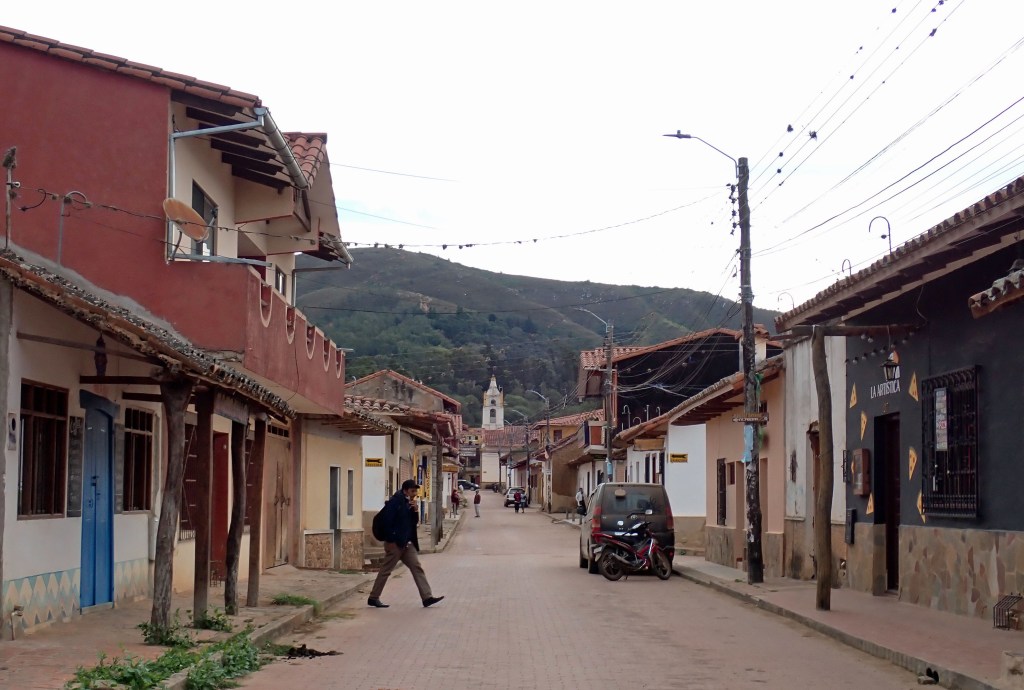
We pounded on the door of the Andoriña until a neighbor noticed and sent a boy to summon the dueña (owner) from down the street. The poor harried woman was working two full time jobs just to keep the place open.
The Andoriña featured gardens, artwork, a kitchen, a mirador with a beautiful view, and countless cats. Our accommodations were simple but nice.

As we walked around town we discovered other quaint hostals, but all were closed.
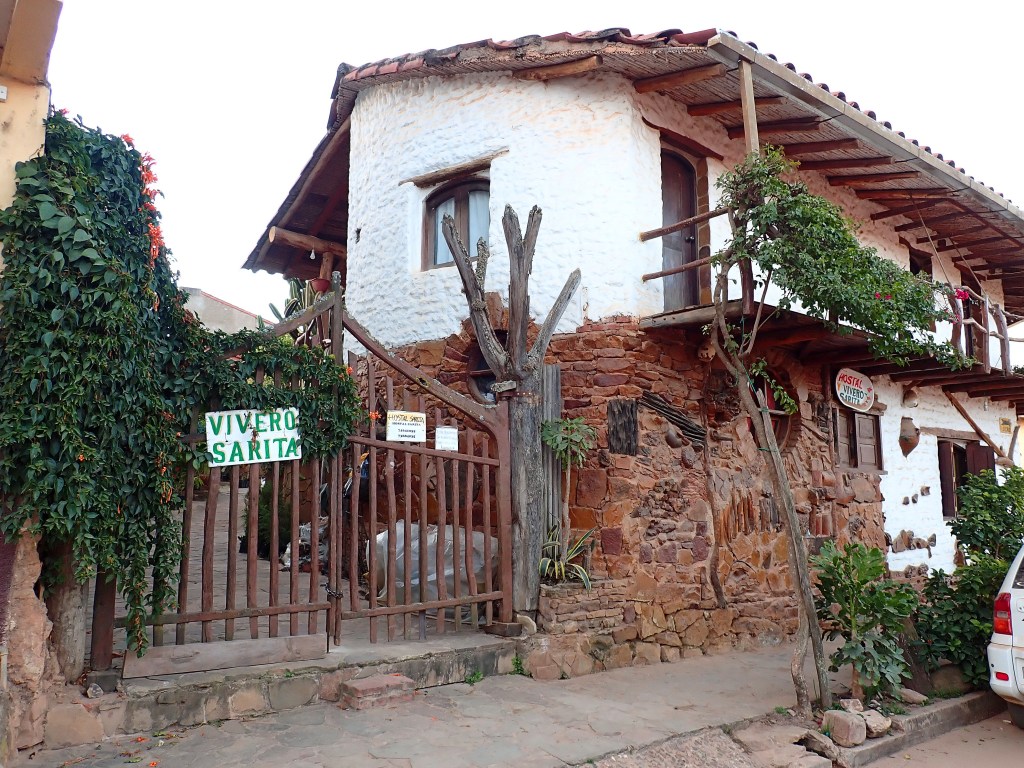
There were signs of Hippies everywhere.

Needless to say there was a leafy plaza.


I was in despair as to where I might find a bite to eat until I discovered La Boheme, a totally cool place owned by an Aussie woman named Kirsty. It turned out to be Bolivia’s best (and apparently only) bar with a clientele of interesting weirdos from around the world. All the other restaurants in town may have been closed, but La Boheme was rocking, and for good reason!

I mentioned interesting weirdos. In one corner sat a fixture named Al, a Canadian lumberjack and oil worker who arrived in 1977 and never left. As you can see from the flag above, anyone can visit La Boheme, but if Al disapproves of your character then Kirsty will give you the boot! Al was a man of strong drink and stronger opinions. Needless to say he had stories to tell.

Unfortunately, Al’s stories were incoherent, and the weather inclement; so, after a few local adventures, we decided to leave Samaipata and head to sunny Cochabamba which was then being ravaged by Covid. What better way to catch Covid than to ride in a stuffed minibus to the epicenter of the pandemic?
Our journey took us over the crest of the first ridge into a series of arid “rain shadow” valleys. In the far distance we could see the main massif of the Andes rising ahead. It appeared that a storm was coming, but I was mistaken.
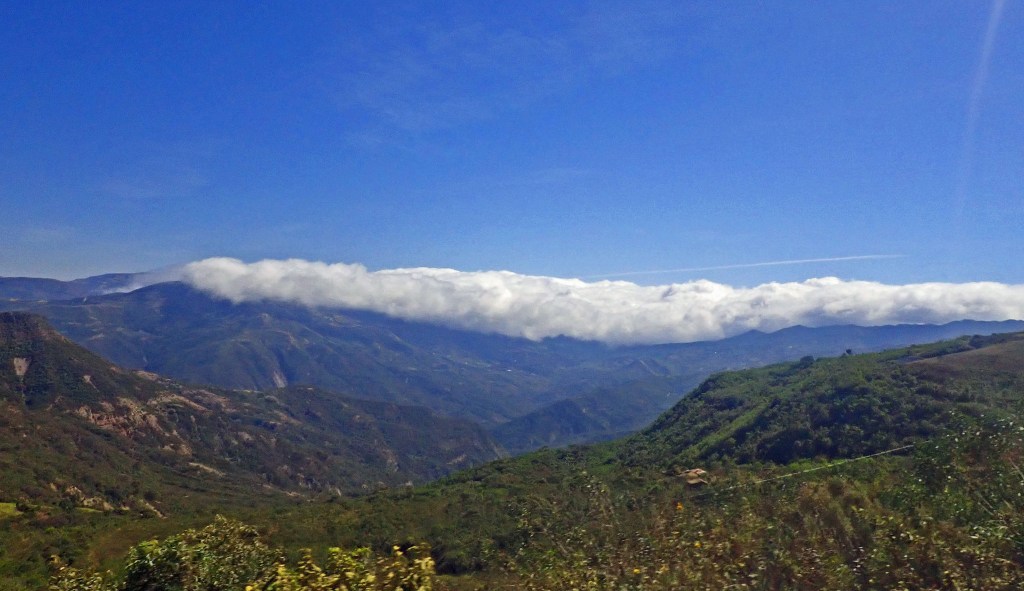
Though tumultuous, the cloud bank was stationary. It wasn’t a storm, but rather the perpetual gloom of the cloud forest. The transition was abrupt. In a moment we went from cold dry sun to sodden clouds where the gnarled forms of small epiphyte laden trees were barely visible through the mist. Just as suddenly we emerged from the clouds to overlook a vast agriculturally rich valley with Cochabamba in the distance.

Cochabamba is Bolivia’s fourth largest city with over a million inhabitants. At 8500 feet it is known as the “City of Eternal Spring”. Though 2000 feet higher than Samaipata, the climate is much more pleasant due to bright sun and warm dry air. Arts and culture are said to flourish.
The Cochabamba valley has incredibly rich soil, and the fields (used to be) well watered by streams that pour down from the adjacent Andes. Cochabamba has long been considered the breadbasket of Bolivia. In colonial times the food grown here sustained the frozen miners who labored atop Cerro Potosi, the proceeds of which made Spain the richest nation on earth. As a result, though lacking in mineral wealth, Cochabamba was a prosperous and peaceful place.
All of that changed in the mid 1980s when the impoverished Bolivian government sought outside investment. Like the Devil appearing before a desperate debtor the World Bank offered assistance. Need I add that it was a Faustian bargain?
The World Bank was of the opinion that “privatization” was the answer to any and all third world problems regarding corruption and/or the inefficient use of natural resources. Nothing could be more efficient than placing everything in the hands of the few.
For millennia the Inca and their predecessors engineered elaborate water management systems featuring irrigation canals, tunnels, and terraces to conserve and equitably distribute the rain that falls on the just and unjust alike. What fools to pass up such an opportunity for profit!
So it came to pass that at the urging of the World Bank then dictator Hugo Banzer cut a sweet deal with a consortium headed by Bechtel International, the world’s biggest baddest war mongering environmentally destructive mega corporation. Once familiar names like Bechtel and Halliburton may have faded from the news, but nothing has changed but the names themselves.
Right wing conspiracy crackpots like to imagine that the world is run by a shadowy cabal of Jewish bankers who meet in Davos to plot the enslavement of all mankind, but they are blithely unaware that the military industrial complex, as exemplified by Bechtel, is doing just that.
The old and equitable water management systems were abandoned and the bulldozers started rolling. Rivers were re-routed, tunnels were bored through mountains, and dams were built. Needless to say the new water supply system prioritized manufacturing and condos over the needs of the poor who were simply left out.
By the turn of the millennium the pot boiled over so to speak, and the Cochabamba Water War broke out. It was a nasty affair. The army stepped in, numerous protestors were shot, labor unions rioted, and the entire country was threatened with a populist revolt. The government and Bechtel backed down to avert catastrophe. These events contributed to the rise of Evo Morales, the only leftist leader of whom I actually approve. As the bus rolled into town the first thing I saw was an ugly brown lake infested with jet skis and surrounded by condos. It was utterly lifeless, a legacy of the Water War.
I hated Cochabamba from the moment I got there. It is a huge sprawling city where what little is left of old colonial charm has been defaced by graffiti. People coughed and hacked from Covid, there was palpable tension in the air, and pounding music penetrated even the thick walls of our flop house hotel.
We had come to Cochabamba because it was the only feasible departure point for a trip to a magical far away place called Torotoro, land of dinosaurs!
Everyone had heard of the place, but no one knew how to get there. We spent a whole day on a wild goose chase only to determine that shared taxis departed for Torotoro from a stop only a few blocks away.
………………………………………………………
Trufis, in this case a minivan, never leave until packed completely full. The Weazel, always the gentleman, offered his seat to a fat lady, but that was a big mistake. On the long journey over twisting mountain roads I had to sit with one butt cheek on the metal edge of a bench seat along with five other people. I couldn’t see anything despite the fact that my face was plastered against the curtained glass of the side window. I was desperate to see the magnificent scenery, but I was out of luck until I haggled with someone in the front to relinquish her seat in exchange for the full cost of the trip.
For the first two hours we passed through desolate paramo, a barren high altitude land of volcanic rocks and dirt with little vegetation and few people other than occasional shepherds. The road was good, and there was almost no traffic. As we sped along I noticed an odd phenomenon regarding the dogs.
Wretched mangy dogs plague every third world country. They frequently wander onto roads, but are adept at avoiding vehicles. Most live adjacent to villages and roam randomly, but along this lonely stretch of road they had developed a dangerous game. The dogs were evenly spaced about a hundred yards apart, and each vied with the other to see which could lay along the side of the road with half their body and outstretched forelegs projecting into the traffic lanes without being killed. They would not flinch even if a speeding truck swerved and passed within an inch of their paws. Our driver swerved too, not out of concern for the worthless dogs, but rather to avoid damage to his vehicle.
The behavior of the dogs reminded me of my days as a hooligan teenager when we would compete to see who would be the last to jump out of the way of a speeding train. There are many behavioral similarities between gangs of young hoodlums and packs of feral dogs. It is difficult for me to decide which group I dislike more.
After dropping off the edge of the paramo into the valley of the Rio Caine the scenery became more dramatic at every turn. In the tilted Google Earth image below you see the reddish soils of the vast synclinal valley of the Rio Caine. The scale can be deceptive, so look closely.

The muddy course of the Rio Caine can be clearly seen. Notice that there is a small but steep escarpment immediately east of the river. It is barely noticeable relative to the much larger mountains surrounding it.
This is what that little bump in the landscape looks like in real life. It blocks the view of the huge mountains beyond.
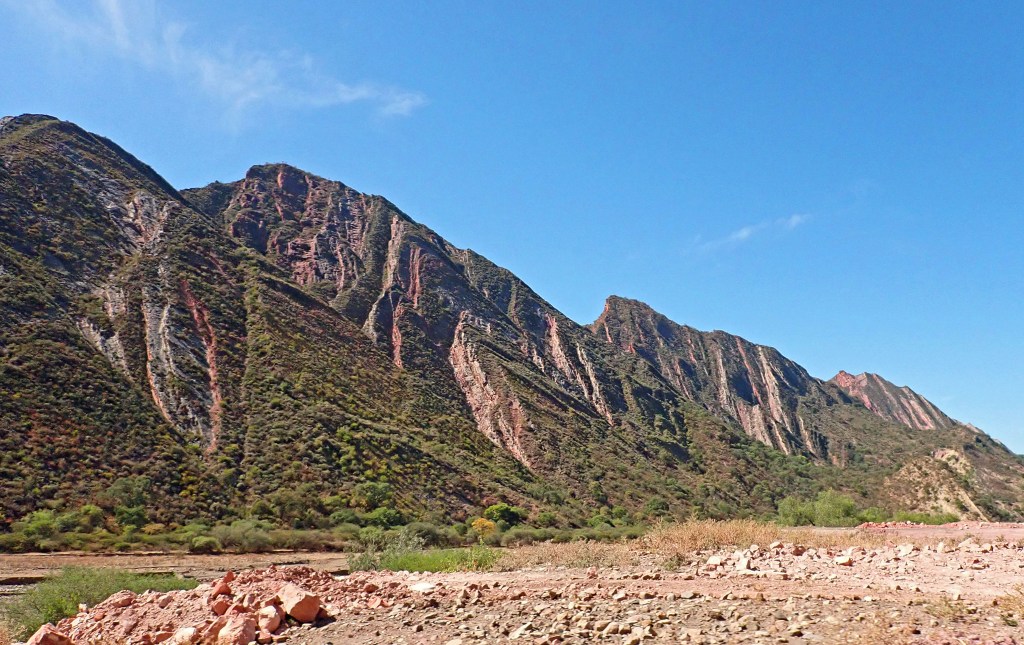
The Rio Caine, here a small stream, is the most remote source of the Rio Madeira, itself the largest tributary to the mighty Amazon. I have no idea how many river miles that entails, but I imagine that if you straightened it all out the watershed would be at least 4000 miles long.
From the Rio Caine we began a seemingly endless switchback ascent of 2500 feet up a huge anticlinal ramp until we arrived at a high valley and the tiny town of Torotoro.
Our trufi stopped in the middle of town by the market. There were a few modern hotels to accommodate visitors, but it was evident that Torotoro was an ancient Quechua village frozen in time, yet one that had fully embraced its future as a tourism destination for the intrepid few willing to travel from distant countries to Bolivia, then tolerate bad roads and primitive conditions in order to visit the fabled Land of Dinosaurs. For the people of Torotoro dinosaurs represent the future, not the past!

The hotel on the corner faced the market. It was a busy place with too many noisy motorcycles for my taste. When I asked about a quieter place the proprietor simply pointed up the peaceful valley. Ann guarded our packs while I went in search of accommodation.
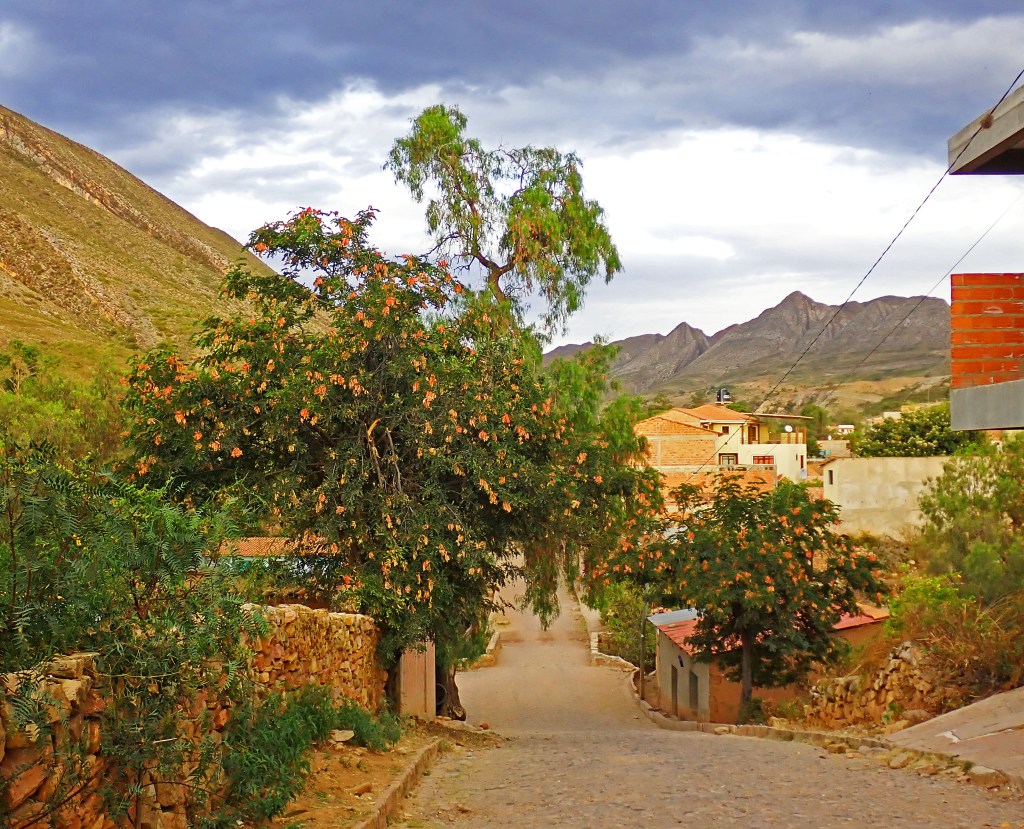
As I walked up the old road I passed several quaint hostels, but all were closed due to Covid. Along the way I admired the beautiful Peruvian pepper trees, Schinus molle, with weeping foliage and clusters of red fruit. Though previously unfamiliar with this particular species, I recognized the genus Schinus due to the abundant fruit. The clusters were similar to the fruits of Schinus terebinthifolia, the so called Brazilian pepper tree, which is a horribly invasive species in south Florida. Birds love the fruit, which is why Schinus is invasive everywhere except in its homeland.
After walking about a quarter of a mile up the valley I was astounded to behold an enormous Pterodactyl perched atop the entrance to a bar. Technically speaking, Pterosaurs are not dinosaurs, but try telling that to a kid!

I learned to read very early in life. At the age of three and a half I was so enamoured of dinosaurs that the very first written word I learned to recognize was, “Tyrannosaurus”. So, when I saw the Encuentro Torotoro Bar it was love at first sight. Poor Ann would have to wait. Imagine my delight to be threatened by a Tyrannosaurus immediately upon walking in the entrance!

The inside of this most excellent establishment was a cave complete with stalactites, and from the cave walls emerged other dinosaurs!
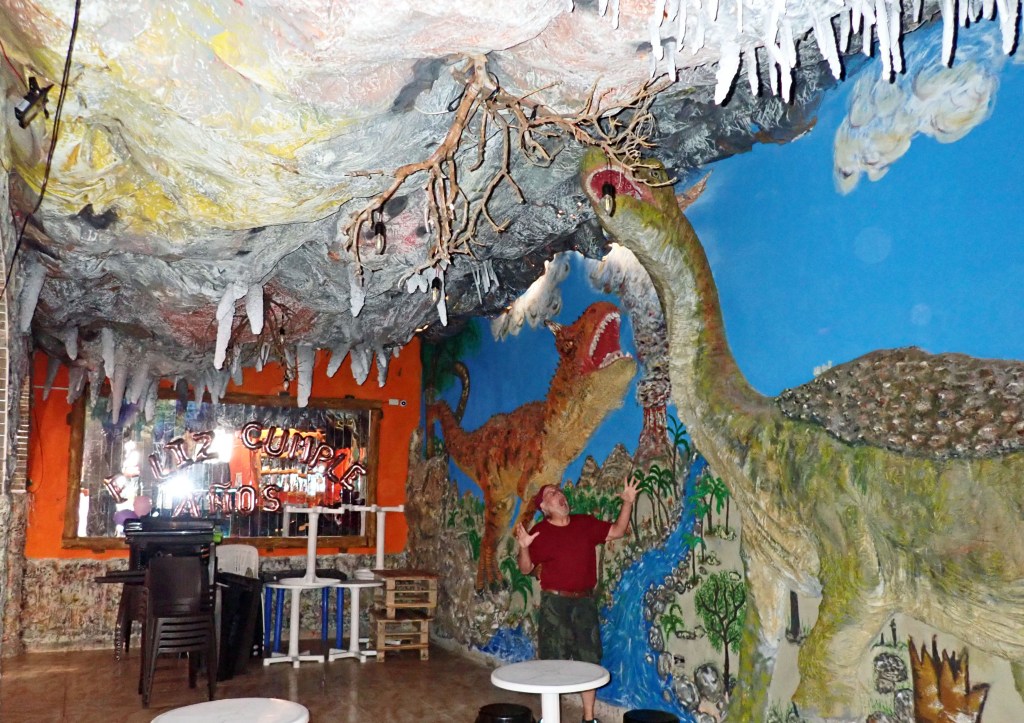
Here you see an herbivorous sauropod, perhaps Diplodocus, munching a lightbulb. Behind the Weazel a carnivorous Ceratosaurus attempts to bite the neck of the hapless herbivore. This photo make it look like these were two dimensional paintings, but they were 3D!

This wonderful place had food and drink, but unfortunately no accommodations. I had so hoped to sleep in a fossil bed! (at least for one evening.)
Aside from a few modern materials such as concrete, everything in Torotoro was made of rocks, dirt, mud, straw, and animal dung. Wood is scarce, as it is throughout the highlands of Bolivia. You can see it all in one photo.

The use of nothing but indigenous earth tone materials has resulted in a timeless ambience suffused with a warm pinkish glow.
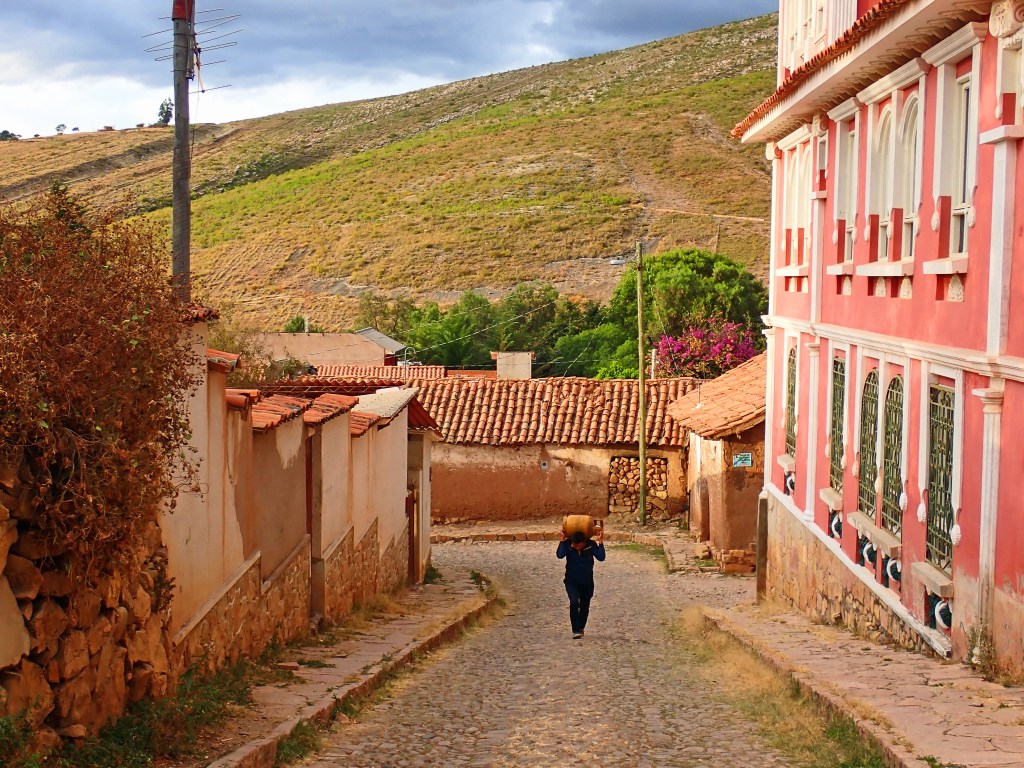
Many of the buildings had been abandoned.

Everyone I saw was an indigenous Quechua Indian. Both men and women wore traditional clothes.

On my way back I detoured through the plaza. There I found an innocent Estonian couple being menaced by a Velociraptor while a Pterodactyl circled behind, eager to feed on whatever scattered body parts remained.
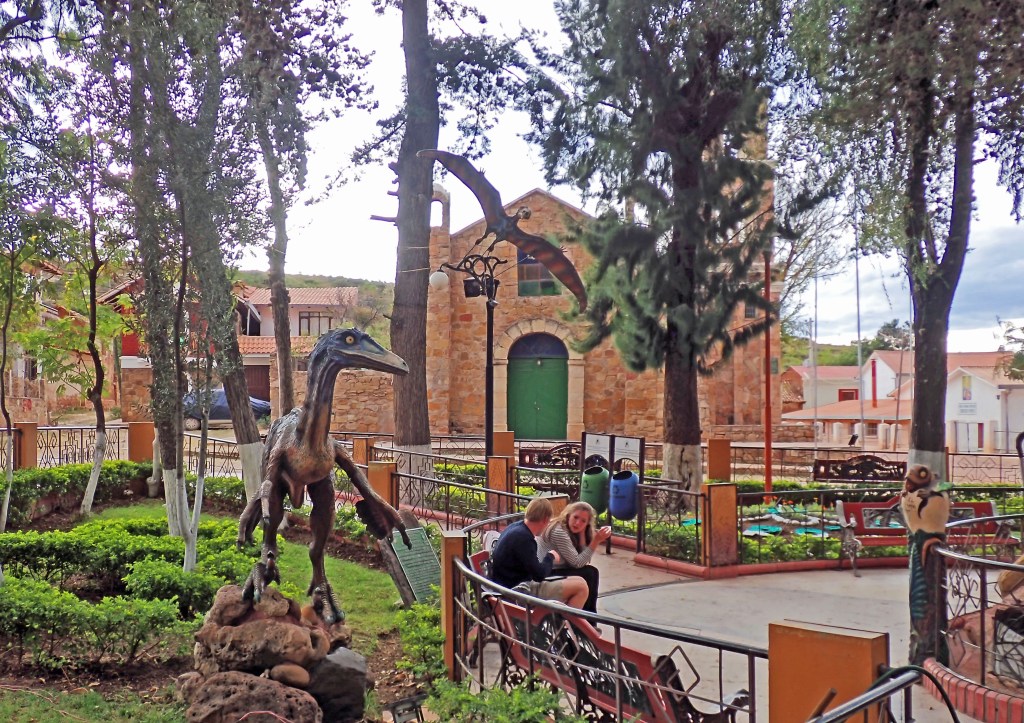
The Velociraptor was so scary that now I fear feral chickens!

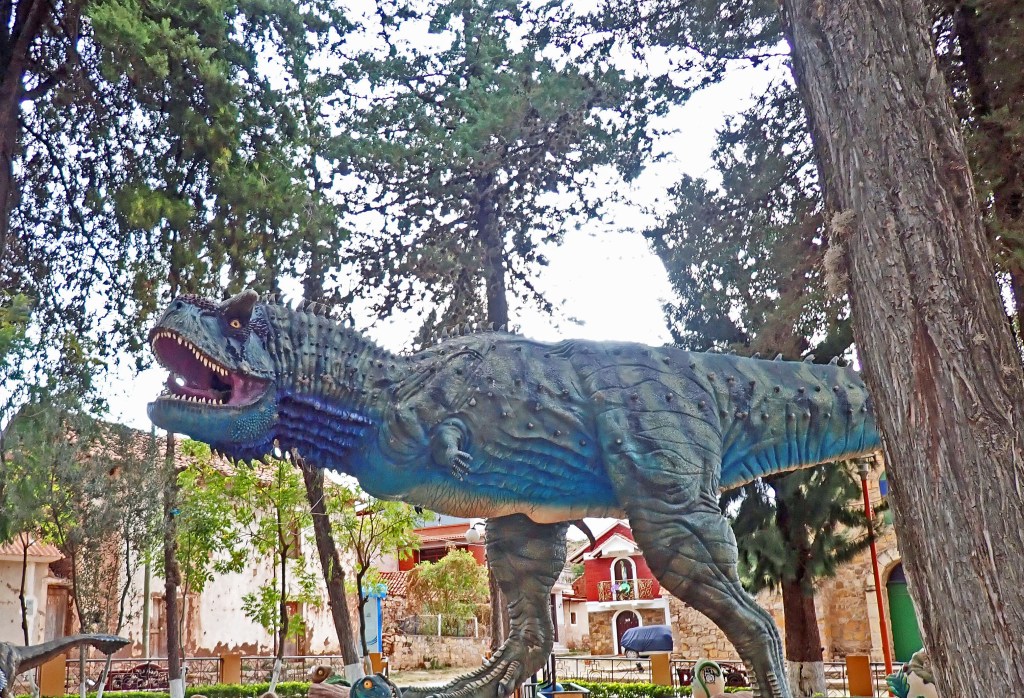
Towering over the scene of carnage was a tremendous Tyrannosaurus!
All the while poor Ann had been waiting by the market with our backpacks. As it turned out, the best hotel in town was only half a block away, so we were soon comfortably ensconced in our otherworldly little village.
There are no dinosaur bones to be found in Torotoro, so by now you must be wondering what, if anything, this ancient Quechua Indian village has to do with dinosaurs?
There are no dinosaur bones to be found in Torotoro, so by now you must be wondering what, if anything, this ancient Quechua Indian village has to do with dinosaurs?
Back in the late Cretaceous, about 80 million years or so ago, long before the rise of the Andes, this part of Bolivia was a swampy landscape adjacent to an arm of a shallow sea. The beach apparently consisted of mud. Further inland there were large lakes that were seasonally rich in vegetation, perfect habitat for the very largest of dinosaurs, the Sauropods, and myriad lesser beasts.
Much like today’s Okavango delta in Botswana, the lakes were presumably seasonal, bone dry at certain times but lush and green at others. To take advantage of the seasonal bounty in Okavango elephants and other herbivores must trek vast distances, and in the wake of their migration come predators such as lions.
So it was in the late Cretaceous when gigantic sauropods would repeatedly trek toward greener pastures while being followed by the most fearsome predators the world has ever known, the Theropods. (Think Tyrannosaurus rex!) Just to pop your bubble, let me remind you that a chicken is also a theropod.
Today we inhabit a diminished world. It is difficult for a contemporary person, much less an urbanite, to comprehend the abundance of life that existed before the advent of man. Not long ago there were thundering herds of bison, and even today there are huge herds of wildebeest in protected reserves like Okavango. Now try to imagine thundering herds of dinosaurs!
For many eons during the Cretaceous great migrations of dinosaurs passed back and forth through the valley now known as Torotoro. In doing so they left behind the greatest concentration of dinosaurs tracks known anywhere in the world. Thousands of tracks can be seen right on the edge of town, and if the overlying sediments and vegetation were to be removed there would no doubt be millions of tracks. Needless to say I had to see them!
Unfortunately, seeing anything in Torotoro National Park requires a tour led by a government certified guide. This requirement supposedly protects the resource, but in reality it is to provide employment for the local Quechua people. Needless to say they are all in favor of a program that provides cash in an otherwise impoverished village. As a result it is nearly impossible to escape their watchful eyes. As I later found out, any tourist wandering alone will be quickly confronted, so there was no choice but to sign up for a tour. The price was right because a small group of tourists, mostly Europeans, had signed up too.
Our guide was a humble campesino, presumably with little education, but he was intelligent and well informed in regard to geology and paleontology. He even understood plate tectonics. To my amazement, despite my poor Spanish, I became the de facto translator for the whole group!
We walked to the edge of town, crossed the little river, then gazed in amazement at a huge slab of tilted rock, the side of the syncline, which had been cleared of vegetation to reveal countless dinosaur tracks!

And hot on its heels came trouble!
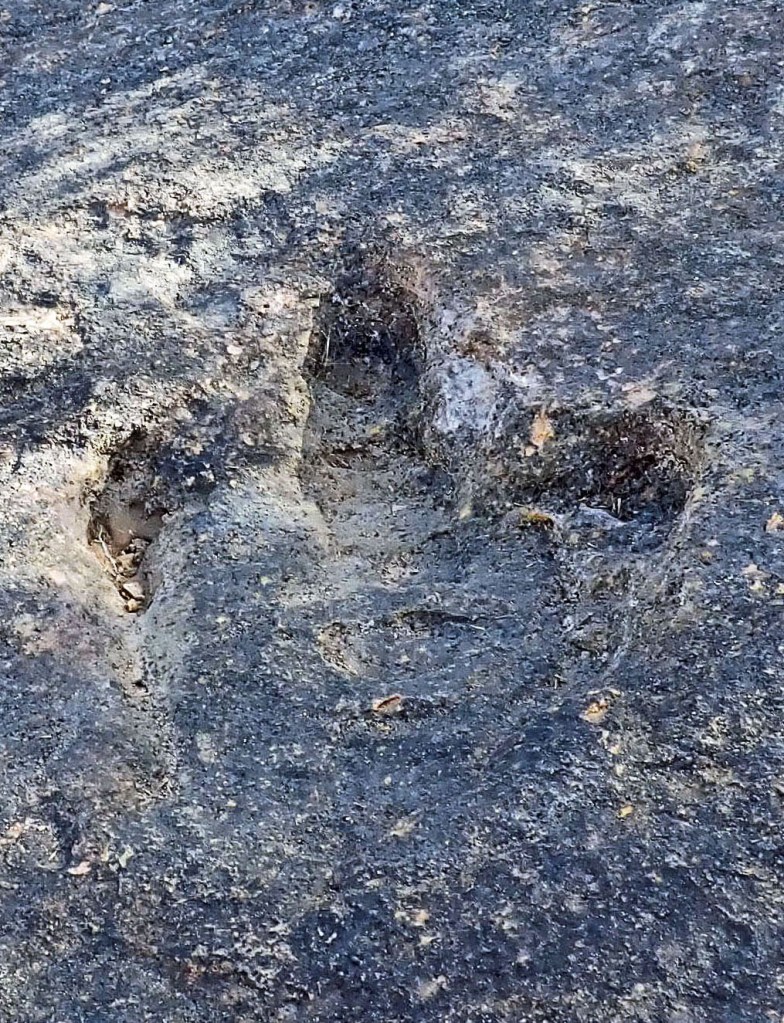
This track is almost two feet long from toe to heel. Could this have been left by a Tyrannosaurus? It is impossible to know with any certainty. In this essay I have taken the liberty of using dinosaur names that are familiar to the public, but may not be technically correct. Aside from that, we still have much to learn about dinosaur taxonomics.
In this essay I have taken the liberty of using dinosaur names that are familiar to the public, but may not be technically correct.
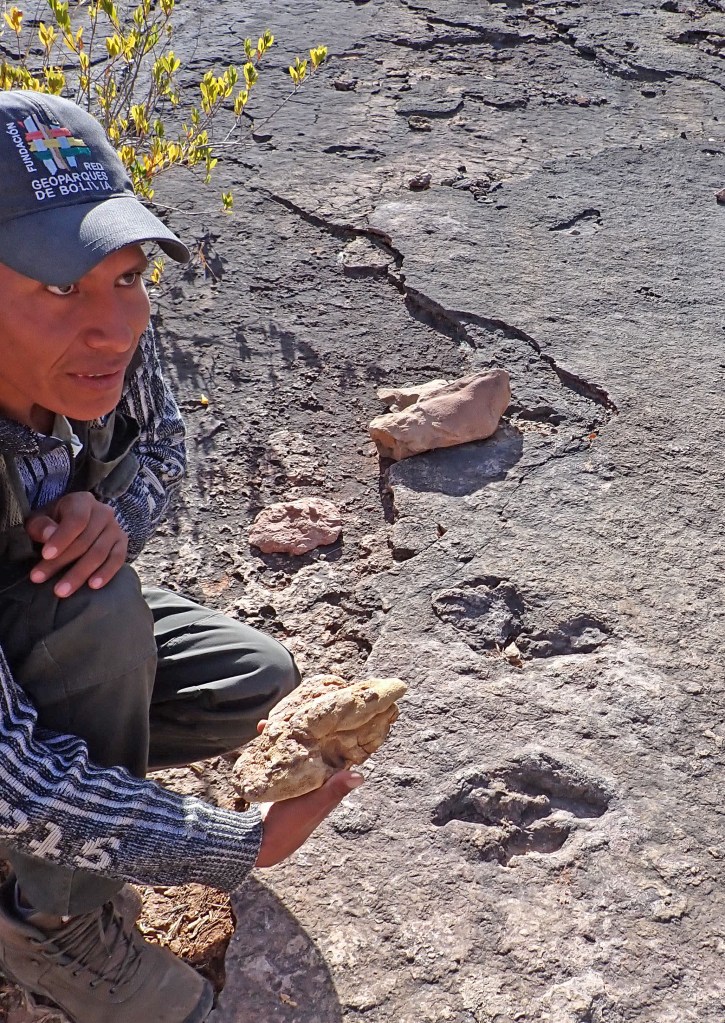
There were many smaller Theropod tracks. In the photo below our guide demonstrates that the tracks include both negative impressions (molds), and positive impressions (casts). These may have been left by a raptor of some sort.
I was surprised to observe that there appeared to be many more predator tracks than those of herbivores. It is a rule of nature that prey must always outnumber predators. One possible explanation for this apparent anomaly is that predators are often more active than prey species. I would further posit that the enormous size of the largest herbivore carcasses, far larger than those of any elephant, could have supported a diverse guild of scavengers, much as we see in the African savanna today.
I was much impressed by the size of many of the tracks, but was unprepared for what was to come. Further down the canyon we came upon unimaginably large tracks that came from the mother of all monsters, some sort of Titanosaurus (sensu lato) perhaps Patagotitan mayorum? I could hardly believe my eyes!
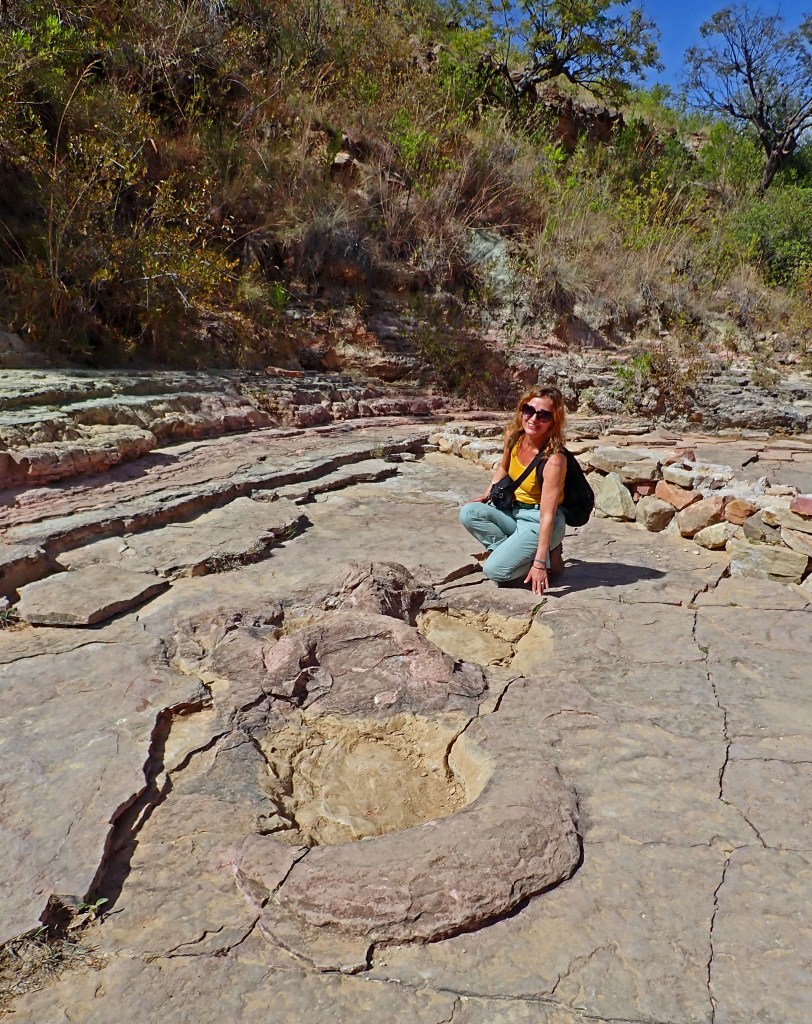
An elephant track is approximately the diameter of a five gallon bucket, but these tracks were almost three feet wide! How big is that? This big.

Now that (I hope) you are suitably impressed, we will pause the narrative.
Join us in the next installment as our jolly crew of dinosaur trackers descends into the Torotoro canyon. There we will encounter no more dinos, but Dr. Ann will come eye to eye with a dinosaur descendant with a twelve foot wingspan!
 Weazelwise