
We followed the enormous dinosaur tracks until they ended at the brink of an abyss where the little Torotoro river plunged into an ever deepening canyon.
Our jolly crew consisted of a local tour guide who spoke only Spanish, a variety of Europeans, mostly Belgian and French, a Jewish Uruguayan hippie, and his stunningly hot Chilean girlfriend. Dr. Ann and I were the only Gringos, for Americans are a provincial lot who rarely venture far abroad.

The upstream stretch of the Torotoro river was nearly dry because this is one of the few places in Bolivia with karst terrain and subsurface drainage.
We were walking on sandstone. Here, as in the Cumberland plateau of Tennessee, layers of limestone and sandstone are often intercalated with sandstone forming an erosion resistant cap. Despite the complex folding of the Andes, there is little exposed limestone in Bolivia, for almost all such sedimentary strata are covered with thick volcanic deposits.
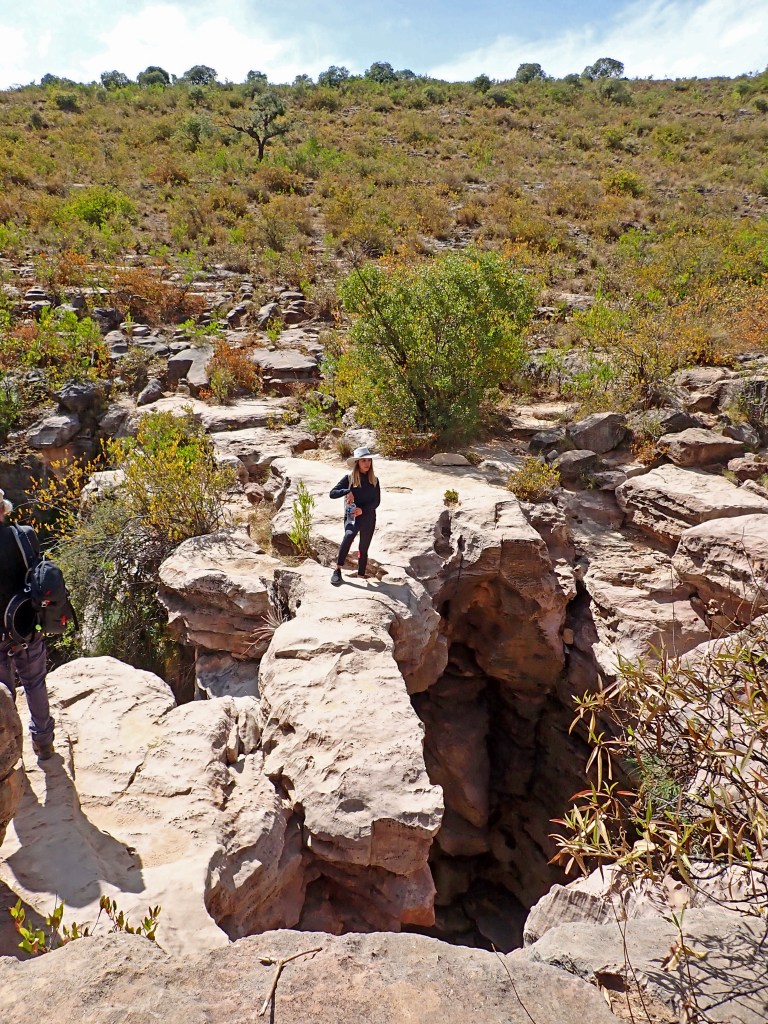
Sandstone often forms natural arches or bridges. So it was in Torotoro where three natural bridges spanned the brinks of dry waterfalls.

Local legend holds that marriage is a perilous undertaking, and that the personalities of two different people must meet in the middle to make a marriage work. So it is that prospective couples must come from opposite sides of the scary stone bridge shown above to make their vows in the middle. Nothing is worse than a dead virgin on her wedding day, so stone pillars were erected to support the ends of the bridge lest it crumble during the ceremony.
Divorce is considered a shame in the Catholic church, as it is among traditional cultures worldwide; therefore, it should be difficult. So it was that unhappy couples who wish to part must walk along the narrow bridge shown below, then cross in the middle before going their separate ways.

Reconciliation is always desirable, but fraught with peril. In this case the peril is a one hundred foot fall into the abyss, there to be consumed by hungry condors.
Despite my bad Spanish I found myself in the unique position of translator, especially of the scientific concepts our guide was trying to convey. I was amazed that such a humble fellow from a remote village could be so well versed in arcane subjects like paleontology and plate tectonics. Conversely, the well educated Europeans knew little of paleontology other than that Barney was a purple dinosaur beloved by children the world over.
Our guide was asked about the name Torotoro. He offered several convoluted explanations, but all were pure bull. I doubted that the name had anything to do with either Spanish (“Toro” means bull in Spanish), or with the Dire Straits’ lyrics, “Toro toro taxi!” Upon further questioning our guide admitted that Torotoro just means “muddy place”.
The trail took us to a point overlooking the canyon far below. There, in the otherwise timeless Bolivian landscape, was an absurdly modernistic cantilevered viewing platform and skywalk.

The skywalk was very well made, and the view was sublime. Though I dislike the style, I favor the whimsey.
Dour first world moralists would say that in a poor country like Bolivia scarce resources should be allocated to housing, healthcare, and education, not to expensive architectural art in obscure tourist venues. In other words, killjoys like the Democrats and the European Union want to use their aid programs to impose the same stultifying regimen of conformity that has dumbed down and domesticated overly civilized people everywhere. But the Quechua of Torotoro don’t care. Though they have little, they have enough, and consider whimsey that celebrates their special place to be money well spent. They are very proud of their overlook, and are delighted whenever a new dinosaur comes to town. Bring on the Pterodactyls!
Speaking of flying monsters, in the distance we could see black dots circling the thermals, and often hanging mid canyon motionless in the wind. They came in two sizes. As they came closer we could see that the little ones were big turkey vultures, and the big ones were enormous condors.
How can two such similar scavengers coexist? There is little to eat in such a barren land, mostly rodents, a few dead dogs or sheep, or perhaps the remains of a puma kill. I believe that relative body size holds the answer.
It is hard to fly, especially for the largest flying bird in the world. The Andean condor has a wingspan of more than ten feet, and a belly built to accommodate large lumps of dead meat. It is even more difficult for such an enormous bird to take off from level ground. Once aloft, the condor simply glides and rarely flaps its wings. It would hardly be worth a condor’s effort to land to eat a dead rat, then to become airborne again.
Before the advent of man wild camelids such as guanacos roamed the Andes, but now they have been almost entirely displaced by domestic livestock like sheep. Were it not for domestic animals I believe the condor would have gone extinct at the end of the Pleistocene, but now, with a steady supply of dead dogs, worn out horses, and sheep that strayed too far from the fold, they seem to be doing well. Few Bolivians own guns, so unlike in North America where the California condor hovers near extinction, lead poisoning from bullets isn’t much of an issue.
As for the turkey vultures, we all know that they relish roadkill, however small, and will flap out of the way at the last moment to avoid being hit by a car. Vultures feed on the ground, and cannot carry their prey away like a raptor, so that poses a problem. I have observed that they seem to be learning (in an evolutionary sense) to drag carcasses to the side of the road so they can feed safely. Such behavioral plasticity, “Catholic” tastes (I have seen them demolish a car to eat the rubber parts), and the ability to rise rapidly from the ground gives turkey vultures the edge over condors in marginal circumstances.
As for the wretched black vultures, which are said to be the primary competitors to condors, I saw none in Torotoro.
Our guide pointed to some little blue pools on the canyon floor far below, then said (in effect) “Who’s up for going down?”
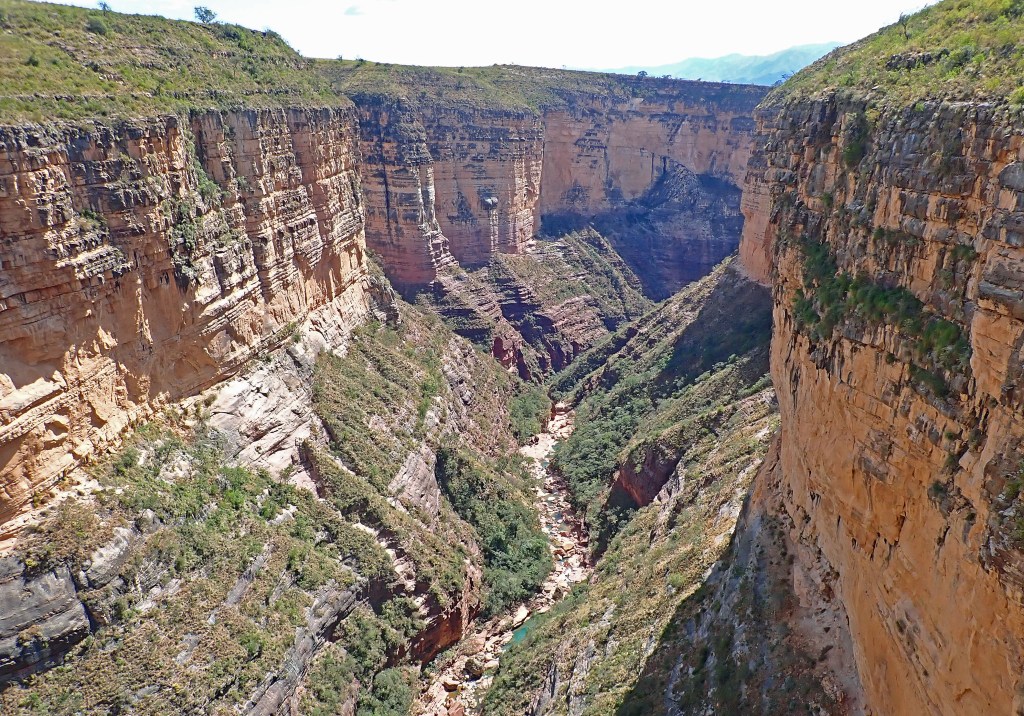
He began an earnest lecture about how long and hard the trip would be. There were hundreds of steep stone steps, and at the bottom it would be necessary to climb boulders, jump from rock to rock, and maybe swim. There was even a sign that said, “No old fat people allowed” Ann and I were the only ones who resembled that remark.
Ann was a bit under the weather, and we were both suffering from altitude, so she wisely decided to stay behind. The guide pointed to another mirador and suggested that she wait there. It was a good choice. The rest of us started down the steep stone steps that clung to the canyon wall.

At a mere 8500 feet, and protected from the wind, the canyon floor was almost tropical, but I wasn’t about to go for a swim. From this point on it was all rock hopping, and the boulders were big!
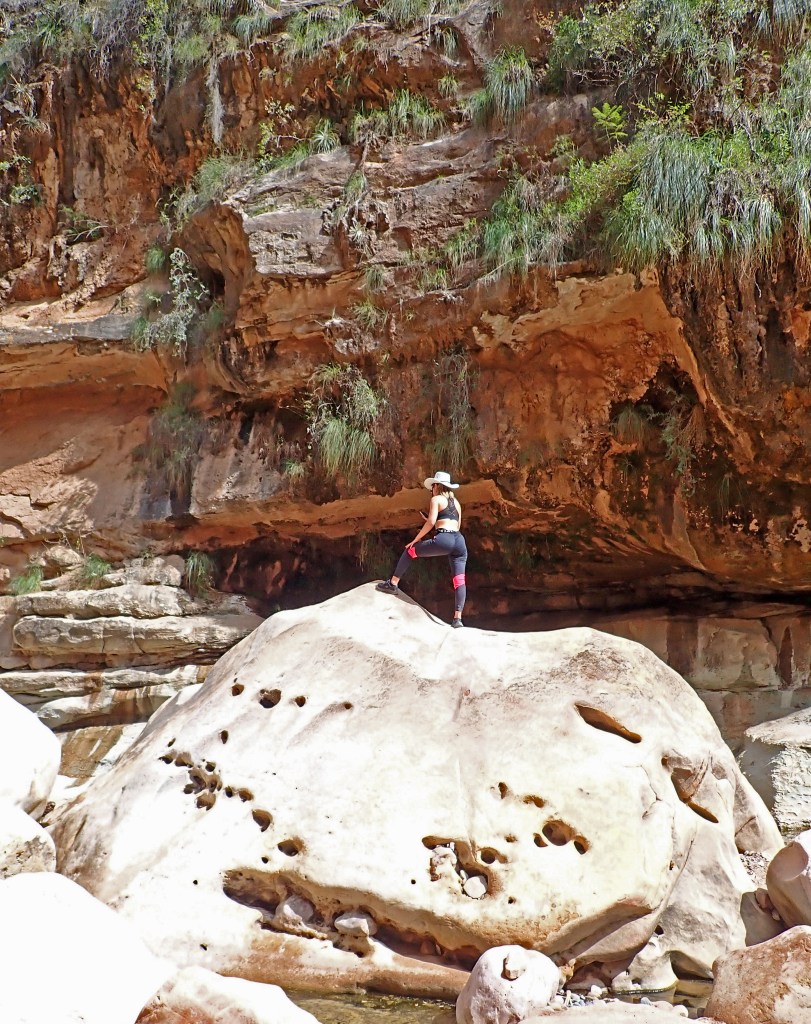
As a certified dirty old man I could not help but admire the shapely form of the Chilean as she scampered up rocks, unencumbered by either age or gravity. She and her boyfriend were the South American equivalent of Hippies, so I secretly nurtured the hope that she would take advantage of one of the blue pools to go skinny dipping. Alas, the water was too cold, and her companions too old.
We continued down the ever narrowing canyon.
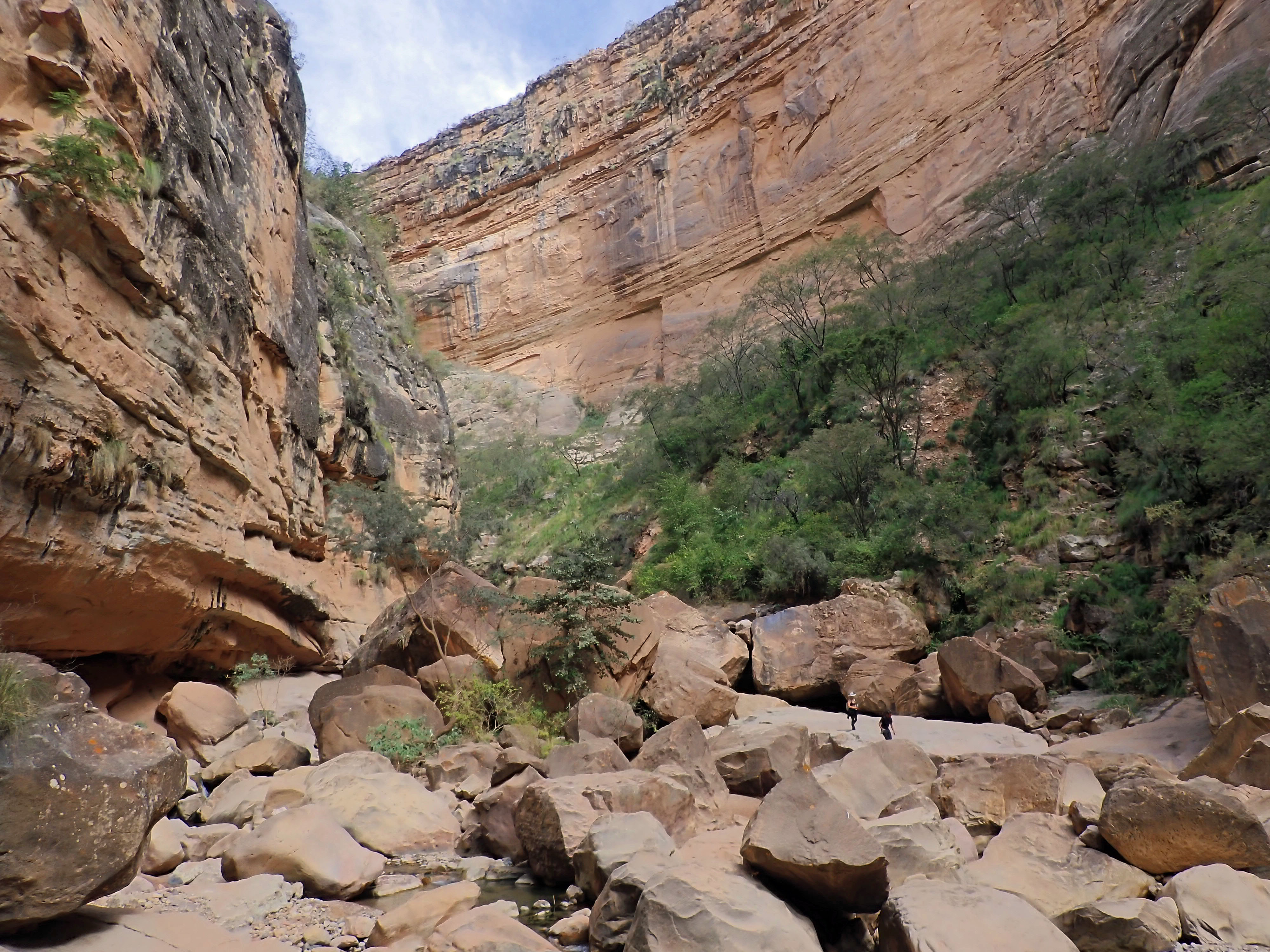
We eventually arrived at a travertine waterfall known as El Vergel which emerges from a narrow band of limestone part way up the canyon wall.
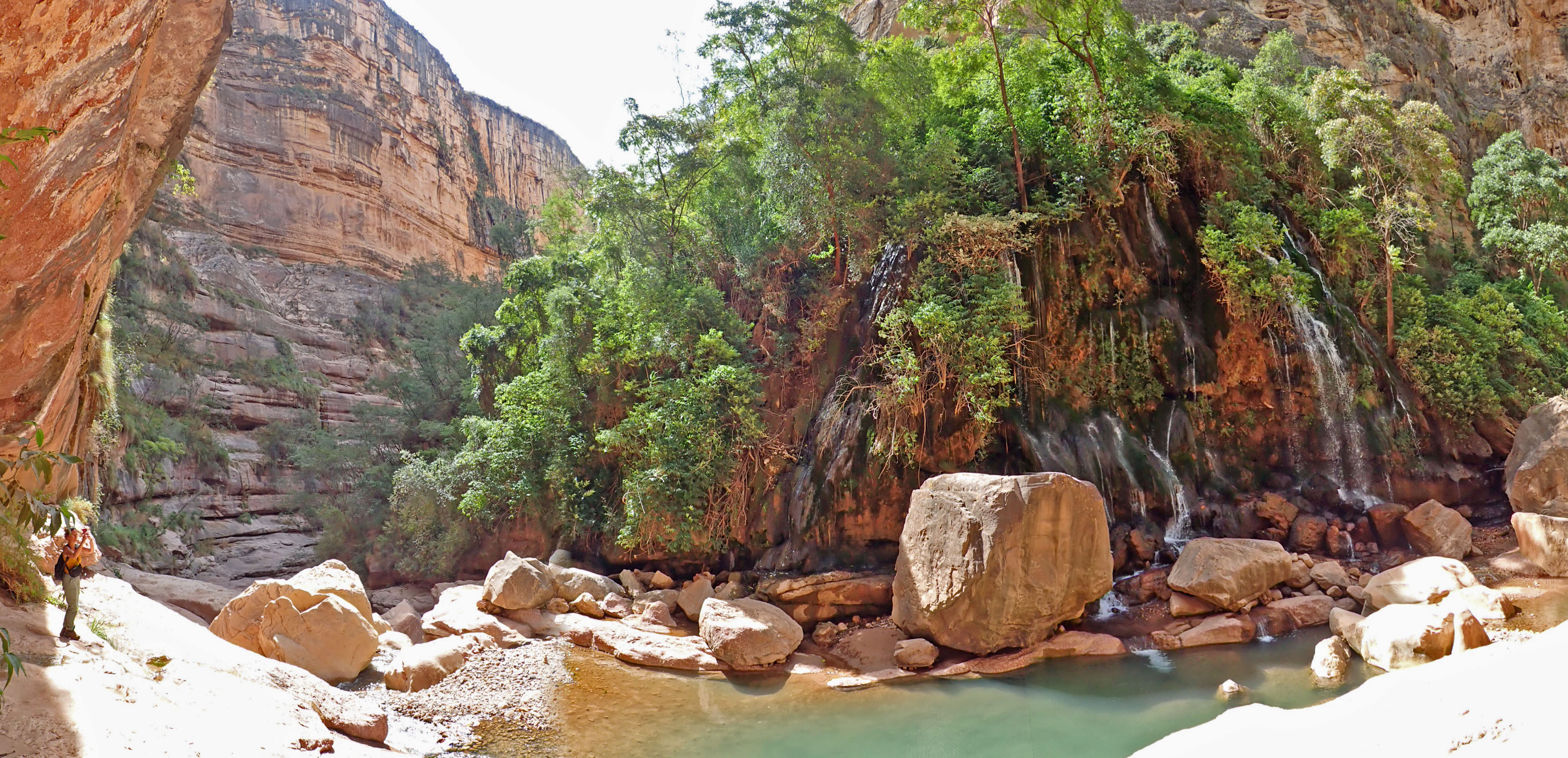
At this juncture we had no choice but to turn back. To continue on would have required ropes, harnesses, and advanced canyoneering techniques. There have been several such expeditions deep into the canyon. In regard to technique, these descents resemble a through trip in a deep multidrop cave, but with the benefit of sunshine. Those who wish to experience the excitement vicariously can view this video: https://www.youtube.com/watch?v=S2knFntfKhs
We began the long trudge back up to the canyon rim. To my chagrin, I had trouble keeping up with my younger companions. Even worse, our guide was very solicitous of me. It was nice of him to wait, but the truth is that he didn’t want to have to carry my corpse if I failed to make it!
Meanwhile, high above us at the mirador overlooking the canyon, Ann had a marvelous experience. Previously, we had only seen condors from a distance, but while she watched from her airie one of the huge flying dinosaurs decided to hover in mid air about fifty feet away while looking at her eye to eye!

The condor was no doubt disappointed that she wasn’t dead.
Next up: Join us as we trek to the one and only large cave in Bolivia, but don’t forget to bring a light!
 Weazelwise