
The Weazel suffers a surfeit of fun, too many adventures to have time to write about them. I have yet to finish chronicling our 2022 adventures in Bolivia, and have not touched upon my 2023 adventures in Ecuador, so forgive me for breaking the narrative chain to bring you a brief report on our recent trip to the Tellico river in southeastern Tennessee.
Those of you with an attention deficit disorder will be pleased that I offer no in depth analysis, just pretty pics of a beautiful place. WordPress tells me that you can read this in 11 minutes. After this post we will return to Bolivia.
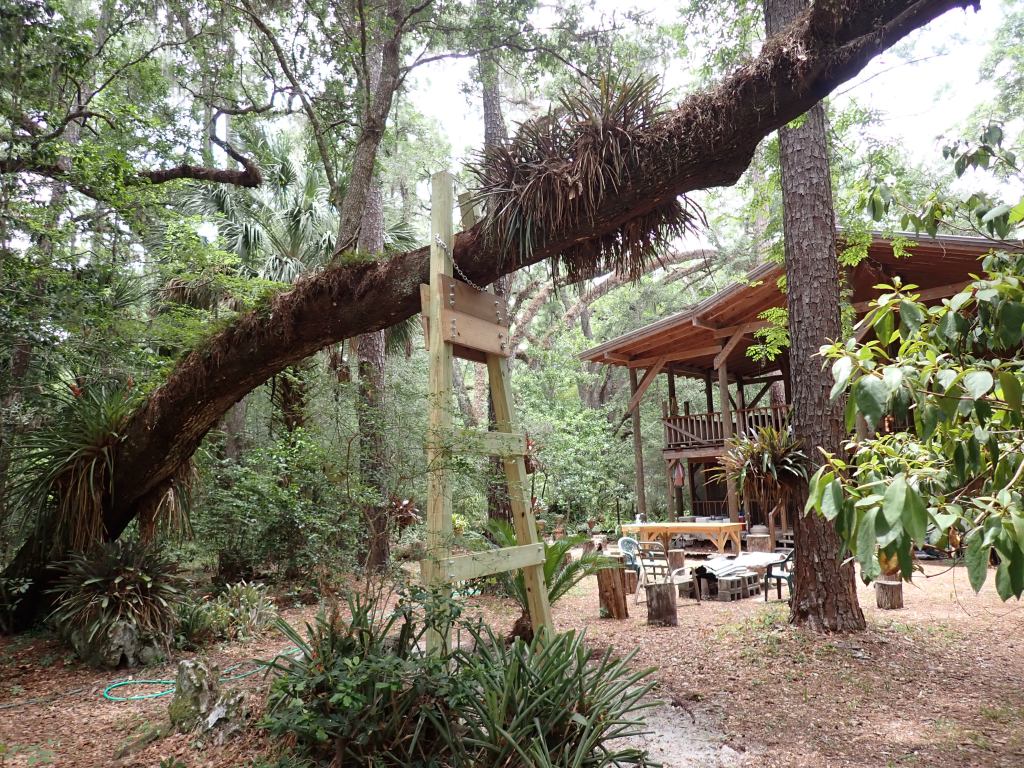
Let me begin by thanking all those who helped to erect the “Tower of Power” in my backyard, a project which Dr. Ann and others labeled a “fools errand”. The problem was how to arrest the toppling over of a multi ton live oak that spans my backyard at an improbable angle. It had recently begun to sag; so, like Atlas with the earth on his shoulders, I proposed to hold it up no matter what. Like Viagra for an elderly oak, it will now stay erect until after I have croaked.
The Tellico River, a tributary of the little Tennessee River, heads up in southeastern Tennessee along the frontier with western North Carolina. Most of its course is within, or adjacent to, the Cherokee National Forest, and the Nantahala National Forest. There are three designated wilderness areas, The Bald River Wilderness, the Citico Wilderness, and the Joyce Kilmer Slickrock wilderness famous for its virgin forest.
The entire area is hard rock country dominated by the Unicoi Mountains, an ancient part of the Appalachian chain with peaks above 5000 feet. Many of the taller peaks are known as “balds“, which is to say grassy windswept meadows above tree line. As you will see, these balds offer expansive views, and are adorned with beautiful flowering shrubs such as wild azaleas.
Just to make you jealous, while most of the country sweltered in the early June heat, at 5000 feet we enjoyed daytime highs in the mid 60s. It was glorious!
We stayed at Spivey Cove, an old CCC camp located at a balmy 1900 feet, and had the place almost completely to ourselves. A road closure kept out the riff raff, and meant that the most convenient place to resupply was Murphy NC, a 58 mile round trip.
Our campsite had good “feng shui”. It was the uppermost site, so we overlooked the access and could see the cops coming in time hide the beer before they arrived. From them I learned the extraordinary fact that in Tennessee it is technically illegal to kill a snake. Most importantly, a tiny pristine stream ran by our site. Just upstream I located a small waterfall in a Rhododendron thicket then built a trail and set of stone steps so that we had an unlimited supply of chilled drinking water.
Right next door to Spivey Cove there is an extremely funky little community named Green Cove. It would make a great location for a grade B “cabin in the woods” slasher flic. The entire place lies along the riverbank, and is only a few hundred yards long. It is densely packed with tiny hand made cabins, none of which meet code. The inhabitants are all antiquated hillbillies, none of whom fish anymore. The tourists do that. It is a miracle that there is any electricity.
The Green Cove store is only open on weekends, and is entirely dedicated to selling a limited selection of overpriced goods to fishermen. I was appalled to see that, along with fancy tied flies, there was an actual pyramid of canned corn. Hatchery trout will eat anything! The friendly store manager is a homegrown entomologist who knows more about the benthic invertebrates than the government fisheries scientists who occasionally come by. Like everyone else, he lives in Green Cove for the sole purpose of trout fishing.

The headwaters of the Tellico has many beautiful tributaries. Not far from our camp was Sycamore Creek, along which runs part of the 300 mile long Benton MacKaye trail. The trail is named for the visionary gentleman who also conceptualized the 2190 mile long Appalachian Trail.

The North River is the largest of the upstream tributaries. The road along the North River provides access to the Cherohala Skyway where we took many of our high altitude hikes.

The Bald River meets the Tellico further downstream. It runs almost entirely within designated wilderness.

Watch your step! The Upper Bald River Wilderness has several stream crossings so we wore sandals. Ann often walks ahead of me. She had passed by several minutes earlier when I looked down to discover that I was about to step on a coppernipper! It was already alert, so she must have stepped within inches.
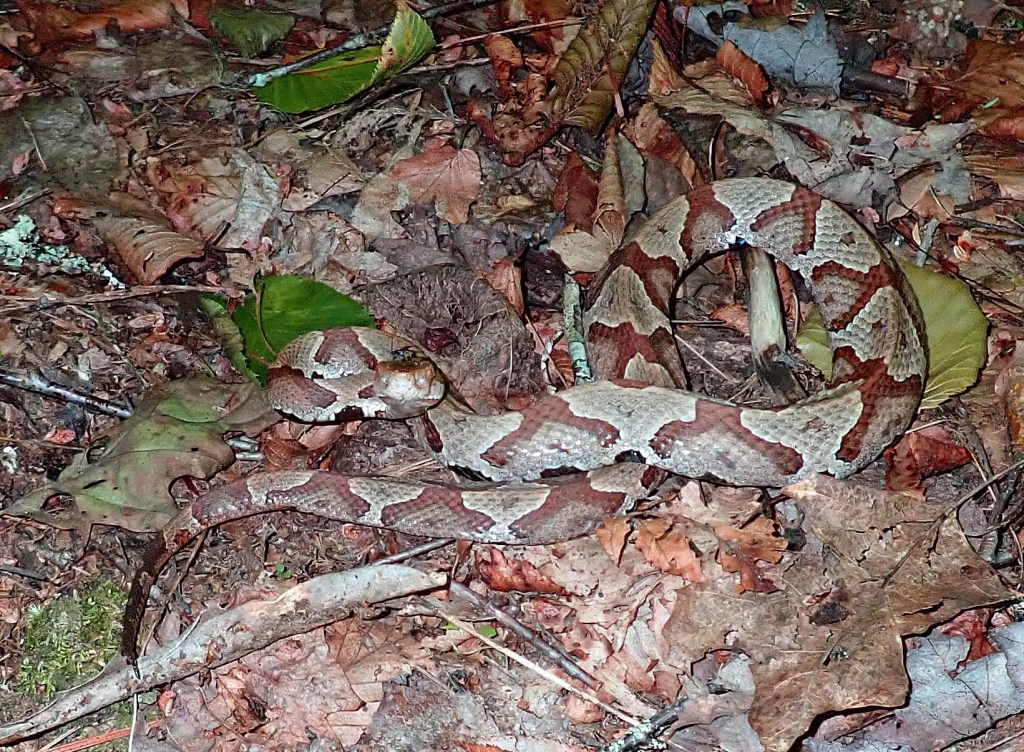
For those who don’t know snakes, look closely at the head. Those prominent whitish spots aren’t eyes, the eyes and nostrils are camouflaged. The white spots are heat sensory pits which are pointed directly at the discrepancy between the ambient temperature and my mammalian warmth. She knew where to bite, but nevertheless, she refused to take offence, and did not protest when I lifted her off the trail with my walking stick.
How different this was from the behavior of a watersnake I found the previous day. It looked very much like a copperhead, and wanted to make sure that I was fooled, so when I approached it flattened its body and struck so violently that it literally threw itself across the road.
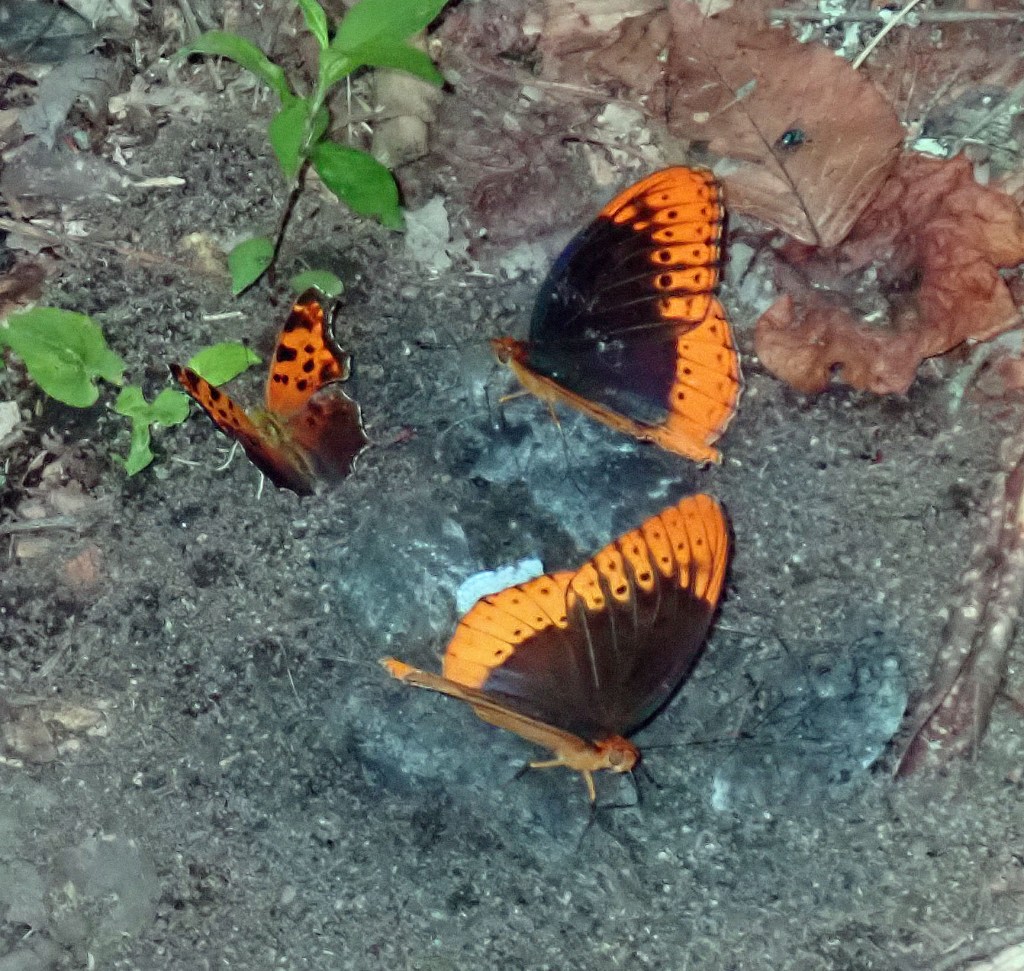
I was pleased to see an abundance of male Diana Fritillaries, Speyeria diana. This large beautiful species is sexually dimorphic, the males are burnt orange, whereas the females are dark blue. For some inexplicable reason the two sexes (Remember, there are only two sexes in any organism!) emerge at different times, and I saw no females. The larvae feed only on violets, but the adults love bear shit!
Another interesting insect was the Pleasing Fungus Beetle, Megalodacne fasciata. On several occasions I found them gathered on Ganoderma tsugae shelf fungus growing on dead hemlocks.
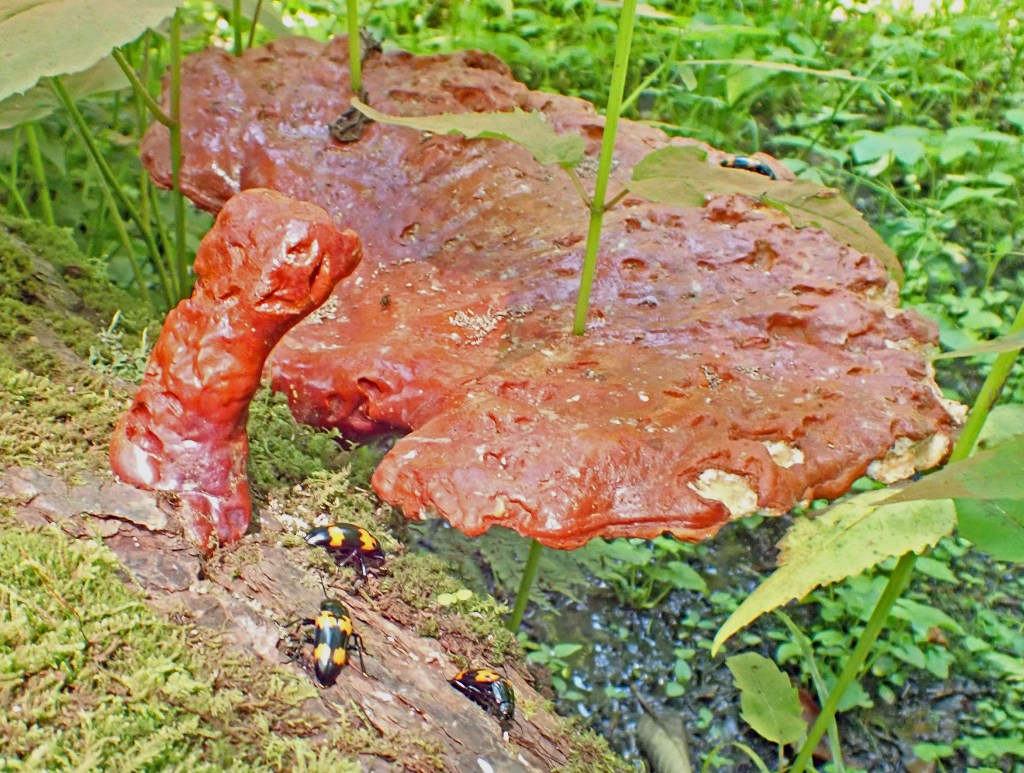
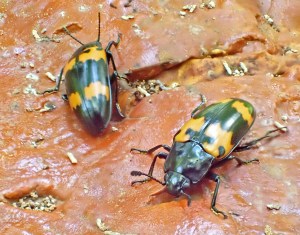
I confused them with the similarly colored and highly endangered Burying Beetle, Nicrophorus americanus.

Because of the similarity of these two different species I cooked up a crackpot theory that the fungus was producing the smell of carrion to “fool” burying beetles into spreading their spores, but I was mistaken. Beware! It is easy to be seduced by “just so” stories, especially your own, in an attempt to understand nature.
One of the main reasons Ann often walks ahead of me is so that I can pause to take photos, and to flip rocks looking for salamanders. In general I was disappointed, but when we went to Jeffrey’s Hell I discovered the mother lode of snot lizards.
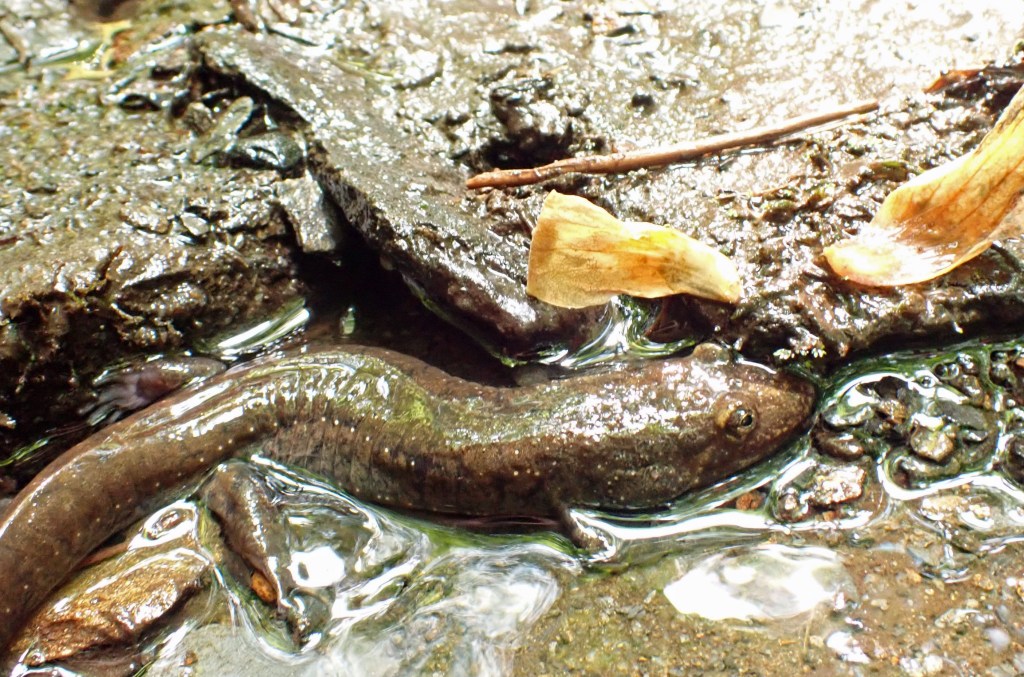
This may be Desmognathus ochrophaeus, or perhaps D. santeetlah. It was so fat it could have been put in a pickle jar with red dye #3 and be sold as a sausage, so perhaps it is a larger species.
Jeffrey’s Hell proved not to be hellish. I had been told that it held the last old growth this side of the Joyce Kilmer Slickrock wilderness, that it was hellish, and that we shouldn’t go there lest we become hopelessly entangled in a Rhododendron dog hobble hell. As for the eponymous Jeffrey, he is quoted as saying, “I’m either gonna find my dawgs or go to Hell”. Some say he was burned up, others say he just got lost, but all agree that he went to Hell.
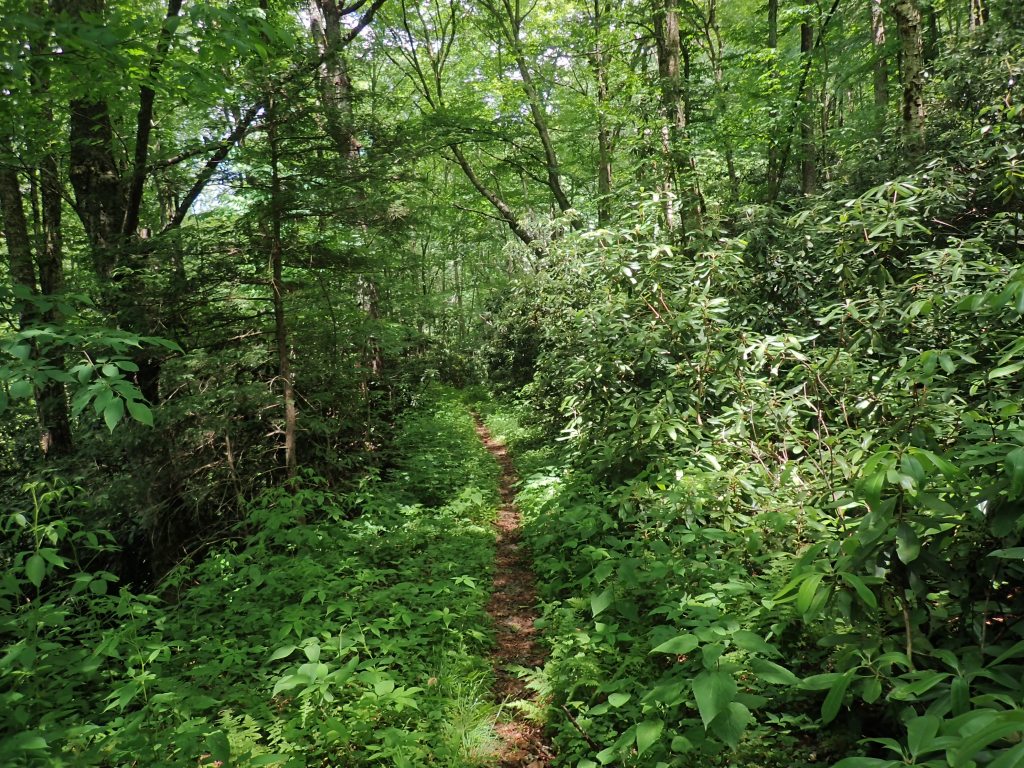
Jeffrey’s Hell is accessed from the Cherohala Skyway, a beautiful high altitude road that crosses the Unicoi Mountains. It is a wonderful drive similar to the Blue ridge Parkway, but it is clogged with well heeled motorcycle hoodlums who come from around the world to ride their expensive Harleys in large groups on the nearby “Tail of the Dragon”. There are wonderful views, and it gives access to many of the nearby balds.
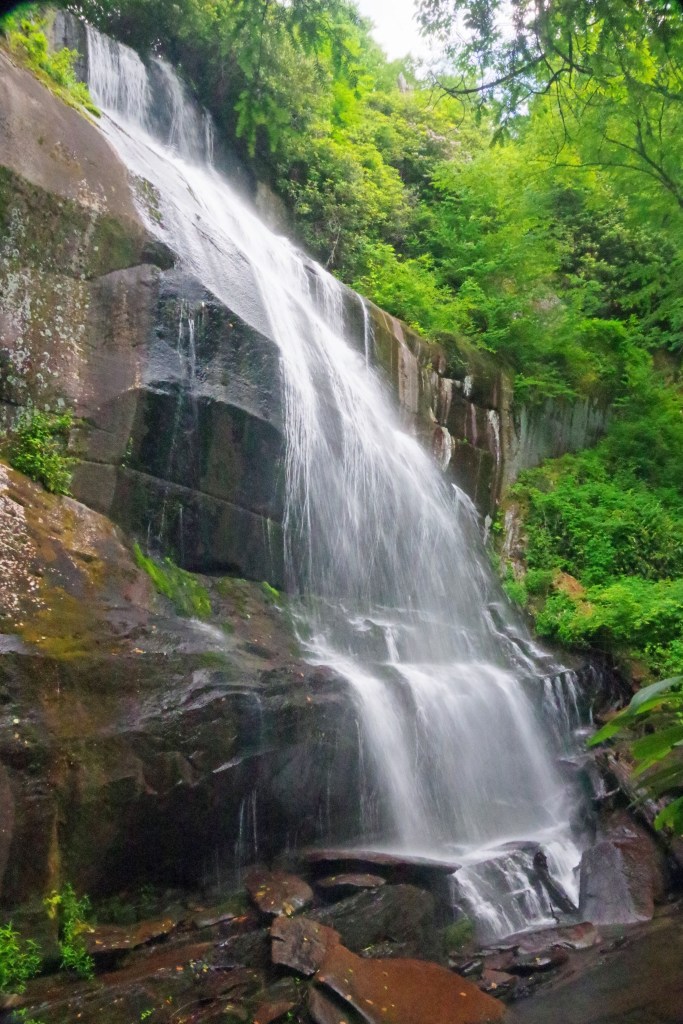
At the same Rattlesnake Rock parking area for Jeffrey’s Hell there is another trail which leads to Falls Branch Falls. The first half of the trail is an old logging road that passes through the usual second growth, but as soon as the trail leaves the level road it enters beautiful old growth forest, some of the only remaining such forest anywhere. It was sad to see that all the giant hemlocks were dead.

The falls are beautiful!
Along the trail I met a Yuppie couple from Chicago, bright, physically fit urbanites. They obviously had no idea what they were looking at, so I explained how rare old growth forest is, and what a shame it is that the hemlocks were gone. She had never heard of a hemlock tree, and asked what difference it made since there are so many other kinds of trees. I was appalled. Her ignorance was typical of urban liberals who imagine themselves to be conservationists, yet know nothing of nature. Such people cannot be depended upon to be steadfast defenders of our nation’s wild heritage.
Further east along the Cherohala Skyway there are several magnificent balds. One would suppose them to have Cherokee names, but they don’t. Most are named for early settlers, but as part of our ongoing attempt to rewrite history and depersonalize place names even the settler’s names have been altered. For example, we have already visited Jeffrey’s Hell, but the map is labeled Jeffrey Hell, no possessives allowed. Likewise Bob’s Bald is now Bob Bald, and Hooper’s Bald is Hooper Bald. The whole point of this senseless renaming is an attempt to downplay whatever heroes the past may have honored, even minor ones like Jefferey. This is part and parcel of the shameful renaming of all places associated with great men (providing that they are men, and white), such as the “cancellation” of Audubon because he once held slaves. Perhaps we should rename the Jefferson Memorial in honor of his brown sugar slave Sally Hemings? I refuse to do it. I will not pervert the English language on behalf of politics.
So it was that we set out on a trek to Bob’s Bald, not Bob Bald. The trail runs along the ridgetop that is also the frontier between Tennessee and North Carolina. It was a lovely walk in the crisp cool air. The trail was easy at first, but became more interesting as the Rhododendrons closed in.

After passing through the heavenly Rhododendron “hell” we emerged on to the open grassy bald. There were beautiful views and we were pleased to see Flame Azaleas in bloom.

Huckleberry Knob, another bald, is the highest peak in the Unicoi Mountains.
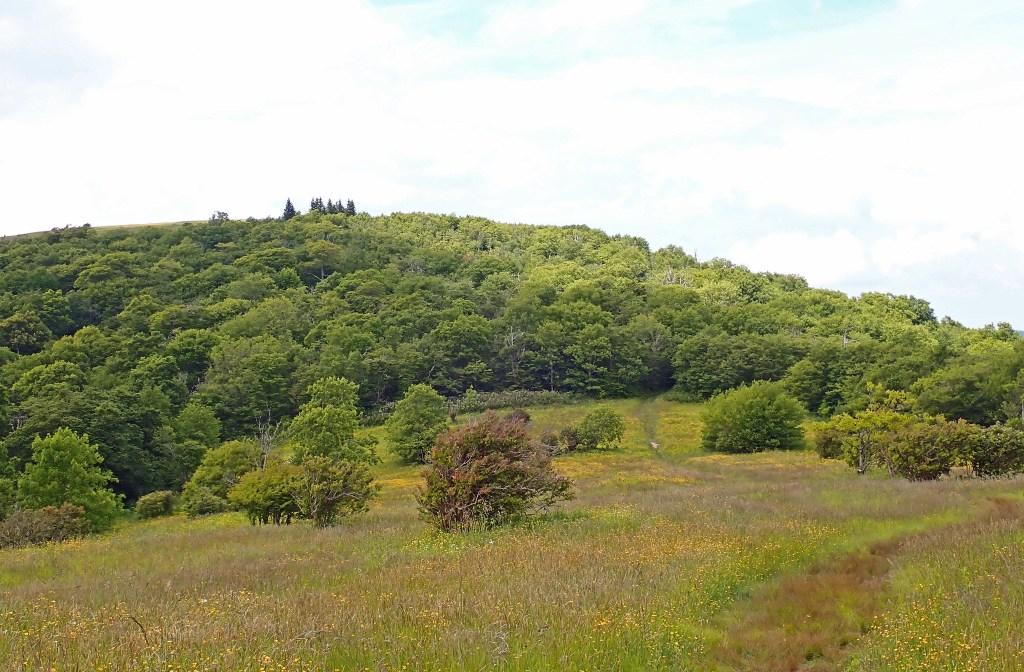
There were expansive views in all directions.

The fields were golden with Buttercups, Ranunculus sp., and there were Huckleberries aplenty! Huckleberries are Ericaceous shrubs similar to blueberries.

There was a simple cross on Huckleberry Knob, and a placard that explained that this was the final resting place of the logger Andy Sherman. In 1899 on a bitter December day he and a friend set out from the confluence of the Tellico River and Sycamore Creek near where we were camped. Their intention was to cross the Unicoi Mountains to spend Christmas in Robbinsville, a daunting trek on vague paths and deer trails. They brought nothing with them other than two jugs of whiskey. The blizzard caught them somewhere near Hooper Bald, so they sat there shivering and swilling until the whiskey was gone, then, as drunks will do, they got separated. His friend’s body was found and given a Christian burial, but poor Andy had been “badly mangled by animals”, so they buried him where they found him atop Huckleberry Knob.
Thus far we had seen a few of the magnificent Flame Azaleas blooming here and there, but we were unprepared for the spectacle that awaited us atop Hooper’s Bald. The bald was ablaze with them!


These blazing beauties were intermingled with some of the finest Mountain Laurels I have ever seen.
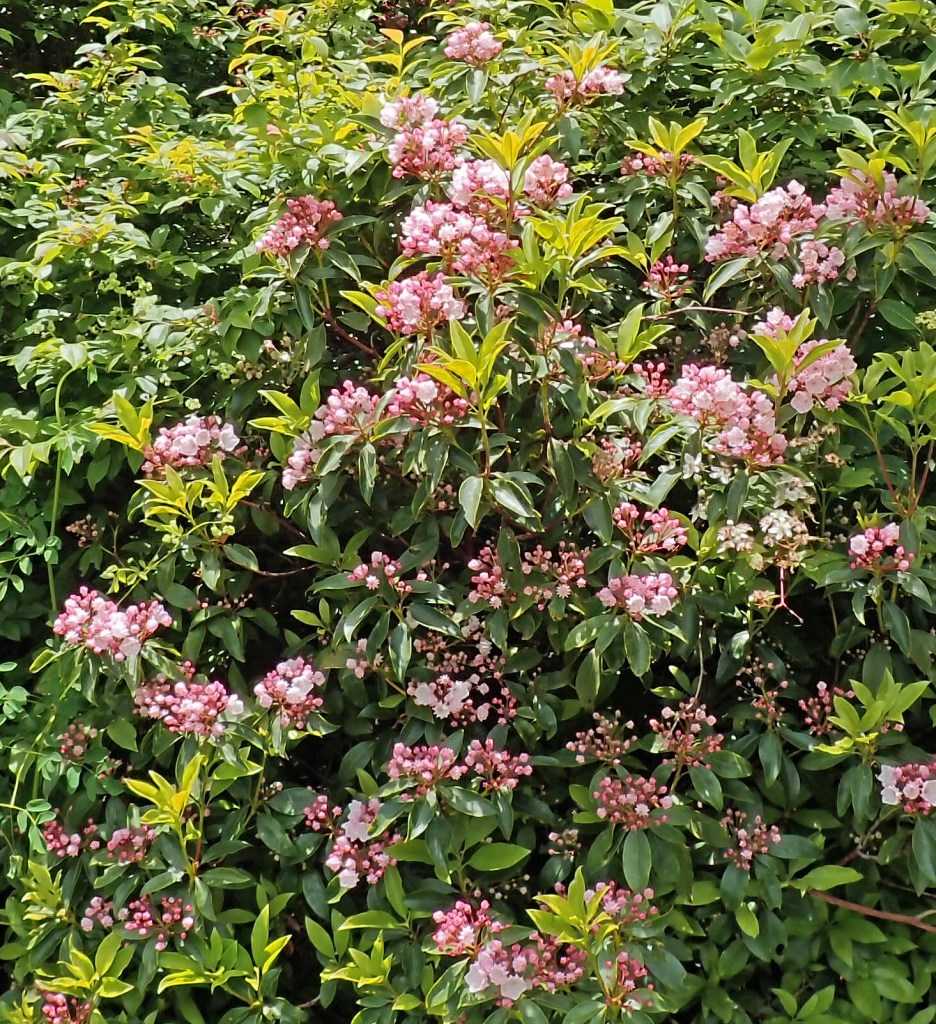
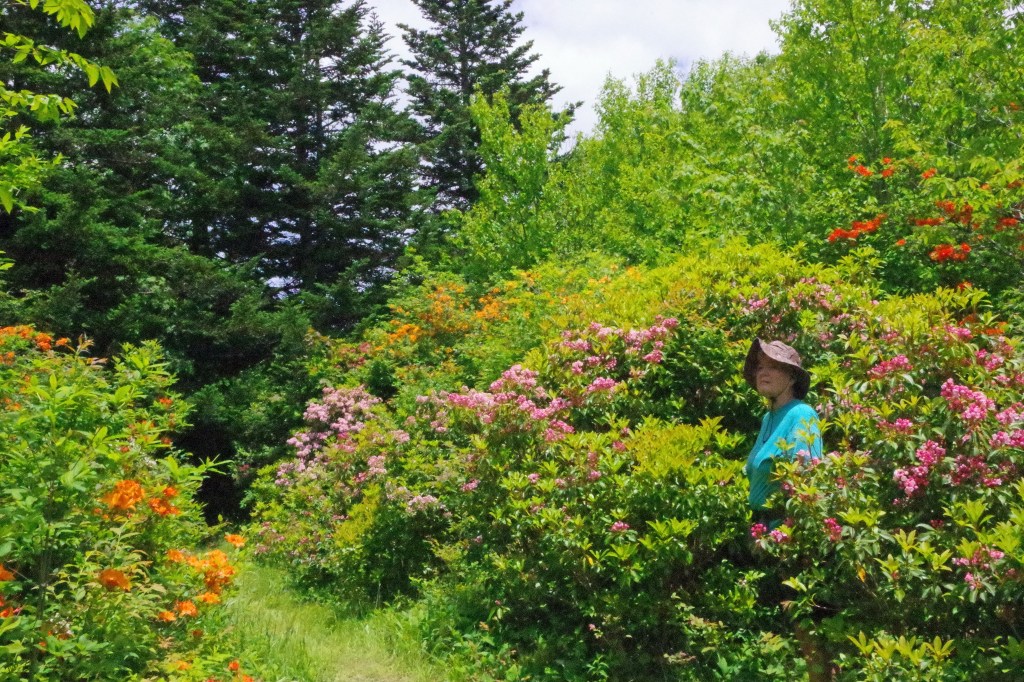
So ended a delightful two week respite from the 100 degree heat and humidity of Florida, but it’s not the heat that’s the problem, it’s the humanity.
Next up: Back to Bolivia!
 Weazelwise