
Long suffering Dr. Ann, who has so often followed me to Hell and back, asks for nothing more than to soak in a hot spring at the end of whatever grueling adventure we have survived. So it was that we headed to Aguas Calientes via Roboré at the butt end of Bolivia.
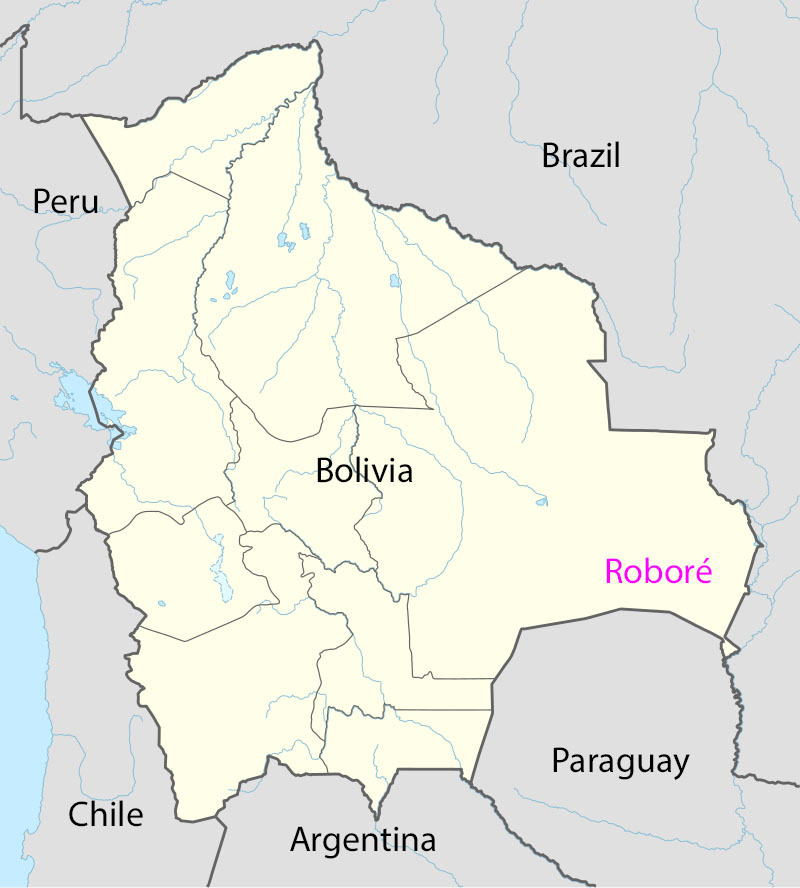
At dawn we left the lovely little town of Santiago de Chiquitos and headed to the rough and ready regional center of Roboré, a place in eastern Bolivia that makes west Texas look good. The fact that there were more horses than vehicles at the big bus stop on the highway tells you something about the place.

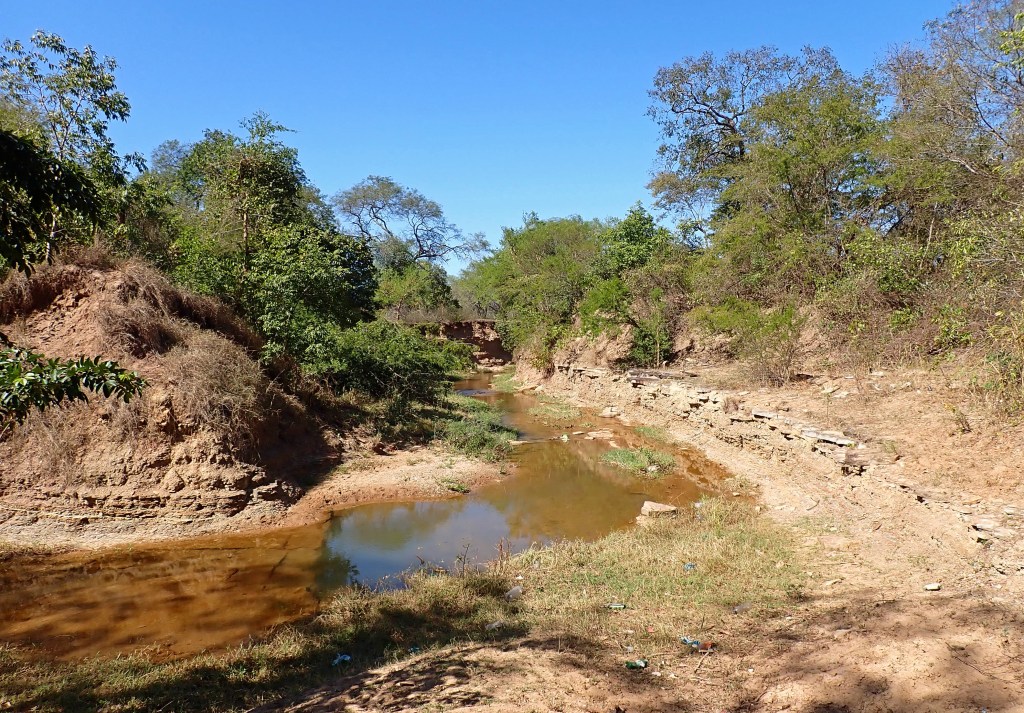
I took a quick stroll into the nearby countryside. The entire place had been eaten to dirt by free ranging horses and cattle. Their innumerable hooves had eroded the banks of a lifeless little river where I searched in vain for a lizard.
A surly taxista took us to the plaza to look for a hotel. He was surly because we were the only game in town, the fare miniscule, and he was being asked to wait.
Lodging thus secured, and the day still young, the taxista took us five kilometers to the trailhead for the Chorro de San Luis. “Chorro” is a word used in Bolivia to describe a stream that gushes or squirts, in other words, a waterfall rather than a cascade.
The trailhead looked like an abandoned refugee camp. The ground was worn bare, and the whole parking area was covered with the pitiful remnants of vendors’ shacks. No one was home. The barren trees, deciduous during the dry Bolivian winter, completed the scene of desolation.

We began the trek down into the gorge, alert to the danger of fire. The thorn scrub, though ugly as sin, looked like a great place for rattlesnakes!
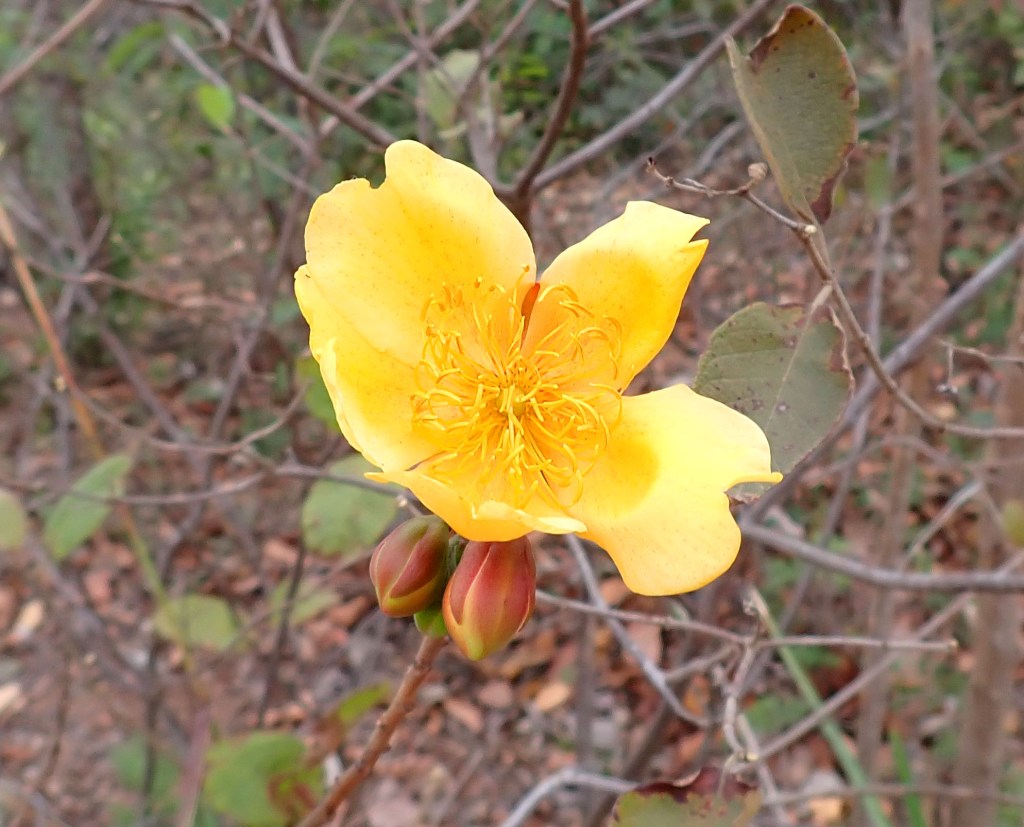
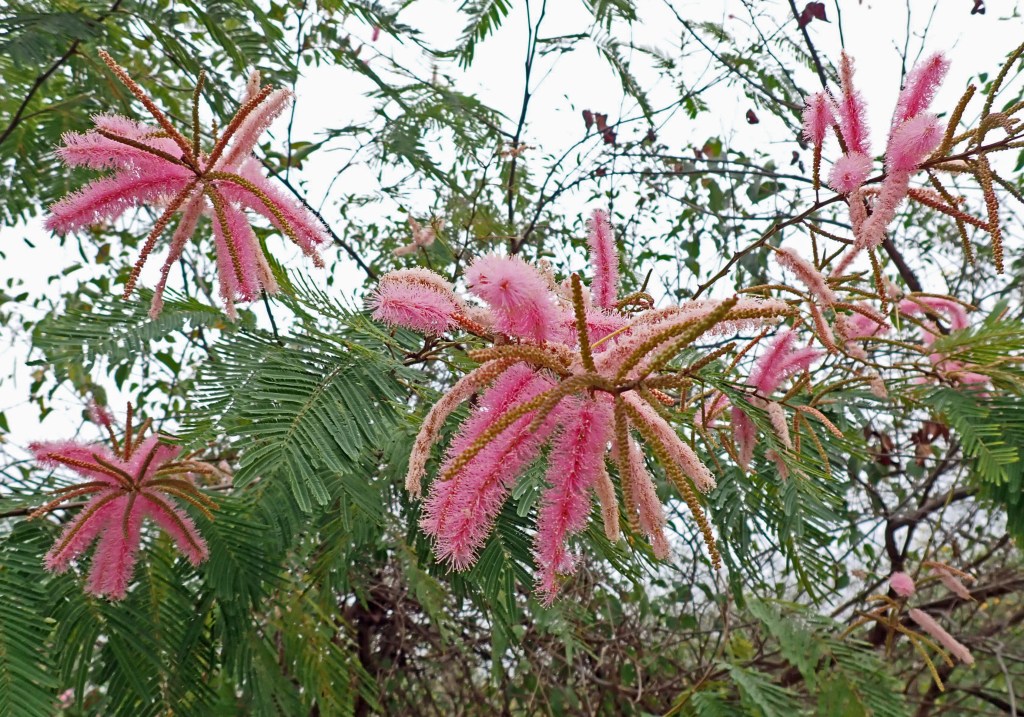
With such a dreary landscape we had few expectations of finding anything beautiful, but we were wrong. Various notable trees such as Tabebuia blossom during the cool dry season.

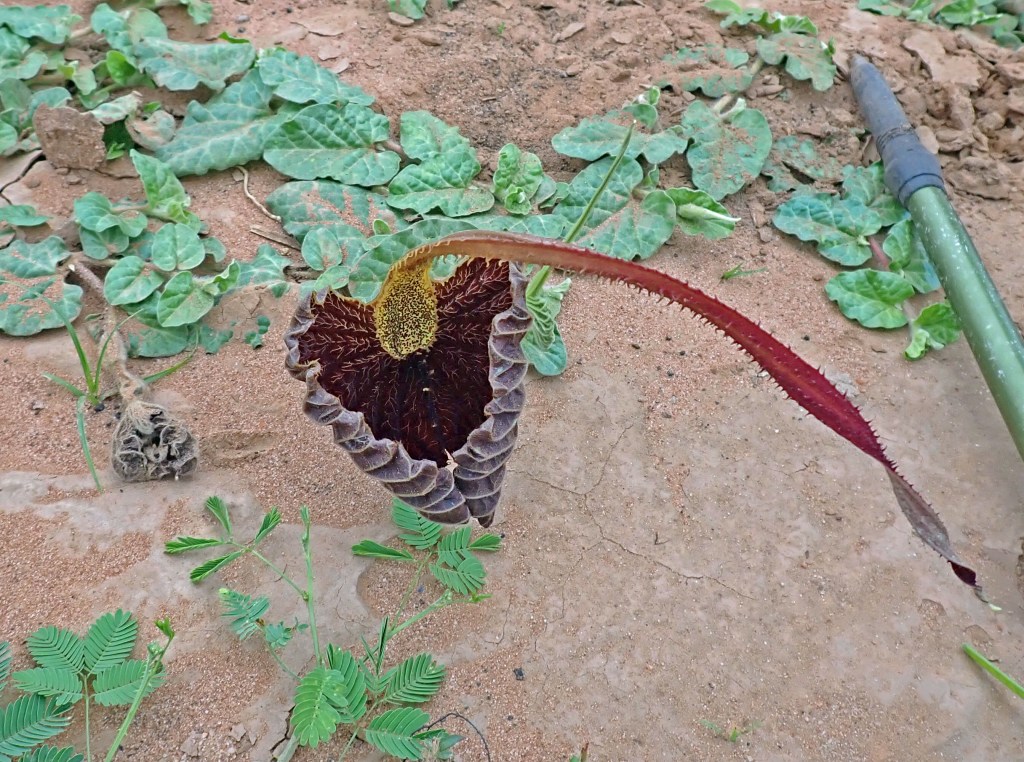
The Aristolochia shown above is exceedingly strange. When the blossom first opens it smells like shit to attract flies. Once inside the deep tubular blossom the fly becomes trapped by downward pointing hairs. As soon as the plant senses the fly’s presence, the pistils (female flower parts) become receptive to any pollen the fly may be carrying. As soon as the plant is convinced that the struggling fly has released all of its pollen the pistils close. At that point the stamens (male flower parts) open up to produce pollen. Once the fly is covered in pollen the downward pointing hairs wilt and fly is released. At first it seems odd that Aristolochias are not carnivorous like pitcher plants of similar appearance, but if they ate the fly the pollen would never be carried to another plant. Take your choice, sex or dinner. You can’t have both.
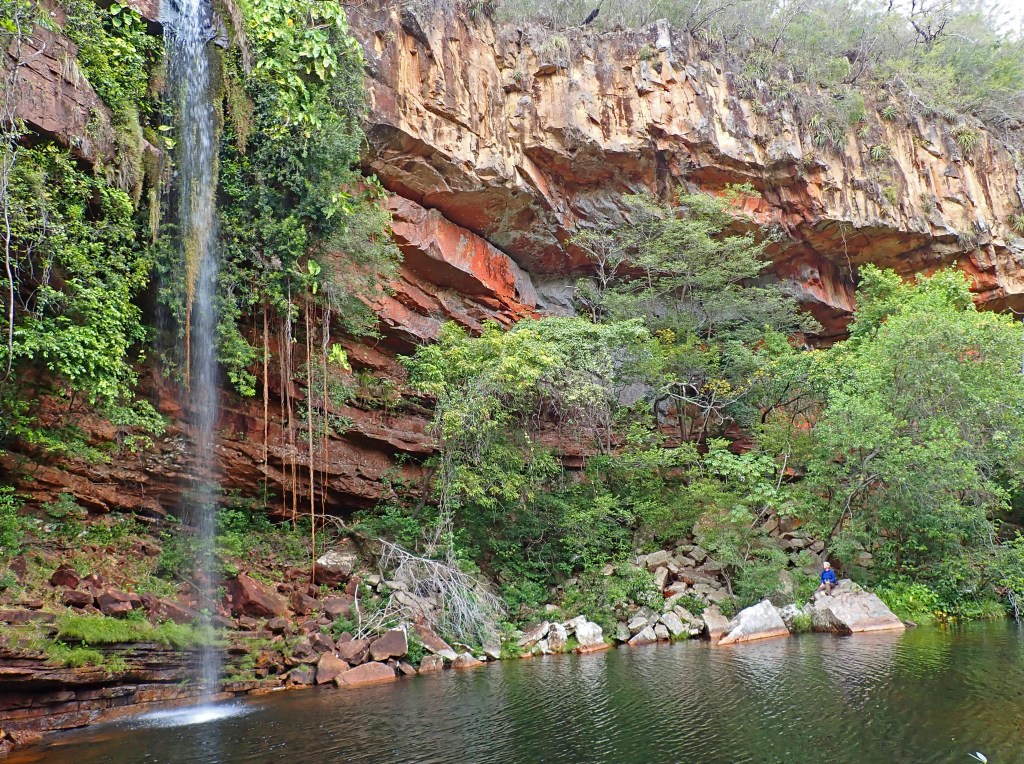
Other than botanical oddities there was little to see until we got to the falls. I never cease to be amazed by how beautiful moist microclimates often are in otherwise dry and scrubby places. Once inside the waterfall basin the trees were big and all was lush and green!

It was a perfect swimming hole, but the cold south wind discouraged even Dr. Ann.

After the long trudge back to town we were famished. Bolivian restaurants are uninspired at best, but the street food is often excellent. An enterprising fellow at the plaza had rigged up a rotating contraption whereby racks of whole chickens could be roasted over a blazing fire. A boy turned the wheel while the proprietor slathered the dripping fat plus salt and spices back onto the chicken. It was sublime!
As we gorged on chicken we were entertained by the antics of the military policemen who attended the nearby college. All were in full uniform. Those guilty of some infraction were forced to stand at attention for hours at a time, while others, two at a time and holding hands, paraded around the square like bashful lovers. All the while a band played ludicrous um-pa-pa music. It was like being in a Gilbert and Sullivan opera!
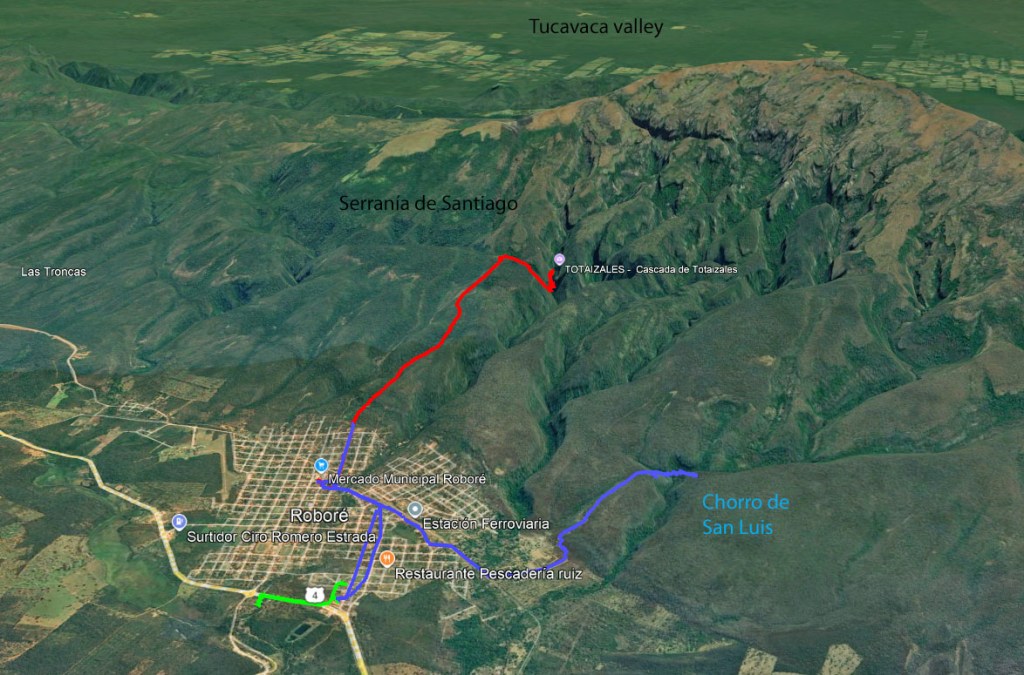
North of Roboré the map showed two area beauty spots, the Cascada de los Helechos (Cascade of the ferns), and the nearby Cascada de Totaizales (Cascade of the Totai Palms).
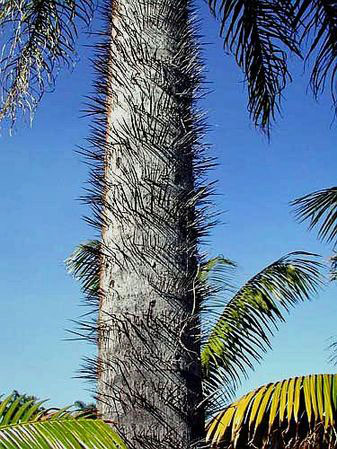
If I had known at the time that the Totai palm was Acrocomia aculeata I might have changed my mind. Acrocomia is among the very worst of the spine palms, and spine palms are among the things I am most afraid of in the jungle. The fruit is tasty and nutritious, like a little coconut, but I’ll leave the harvesting to you.
It wasn’t clear how to get to either place, so we asked around. The surly taxista, who had no other customers, and had thus taken a liking to us, said, “I know where the trailhead is, but both cascades are a long ways from here. When I was a boy I could get there in an hour, but that was then and this is now. I’ve never been back”.
From the edge of town we began the long ascent. The dusty road seemed to go on forever.
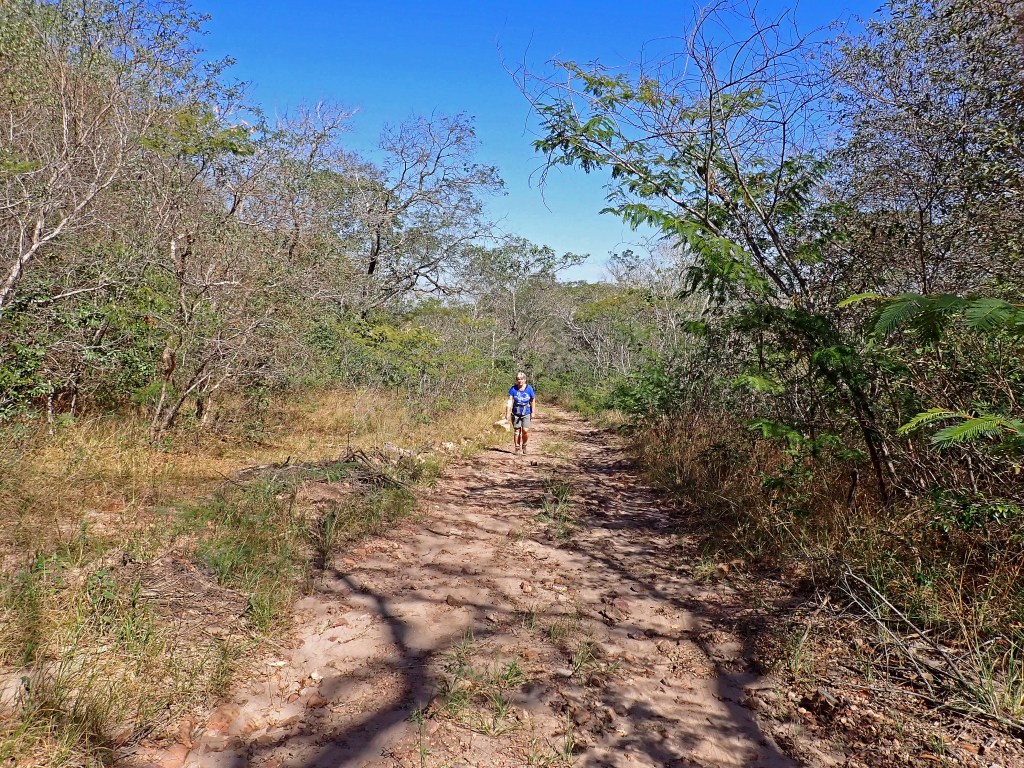
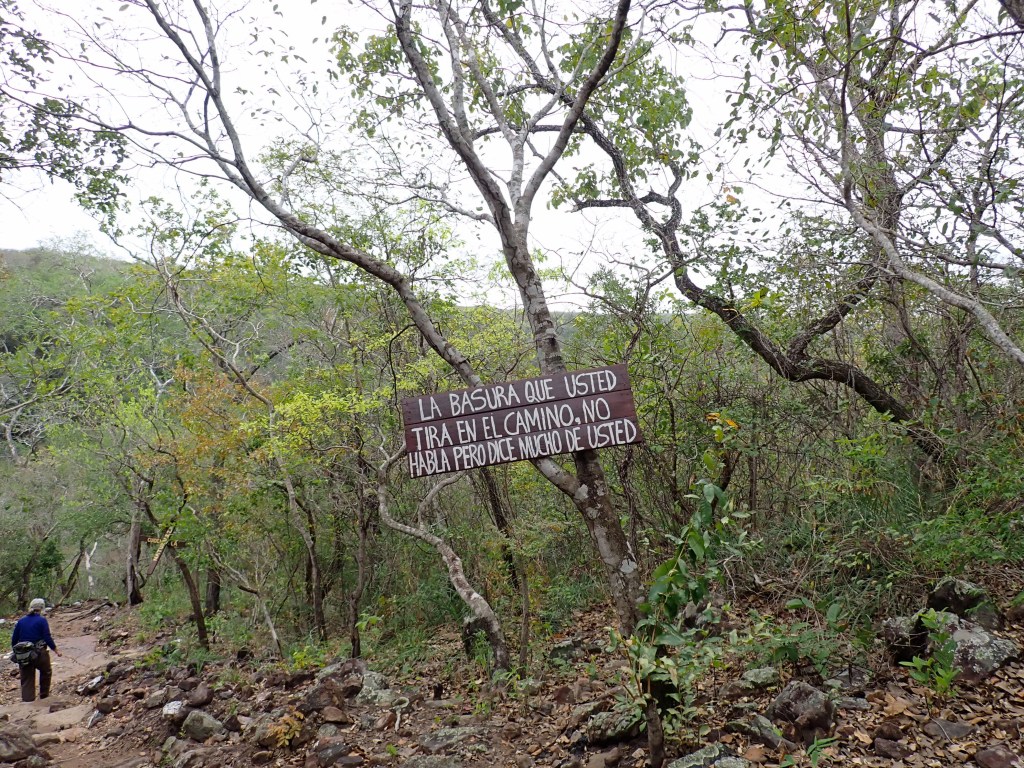
After several miles and an ascent of over 1000 feet we reached a ruined cabin where the trails diverged. Totaizales was said to be more interesting, but more difficult of access, so Ann elected to visit the ferns rather than the spine palms. To my amazement, there was even a sign.
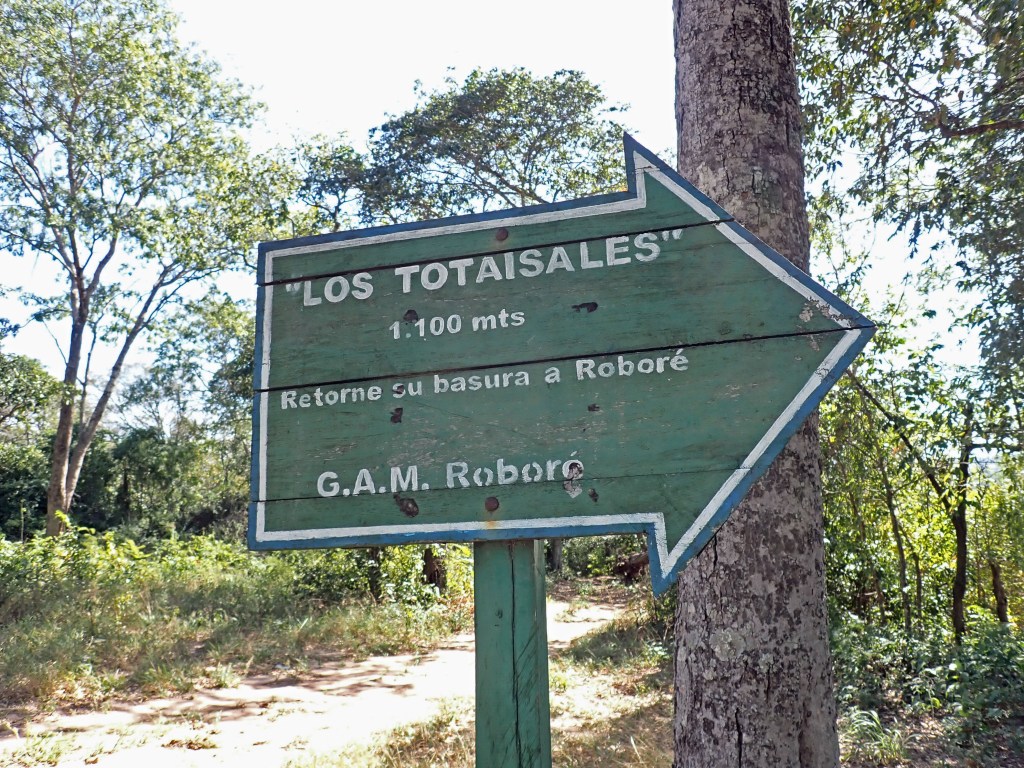
As is so often the case, the trail disappeared into ruined grassland, but became more easily discernable as I descended into the forest. After a steep scramble I reached a small stream. The trail disappeared entirely, so I continued upstream through a series of beautiful but difficult to traverse potholes.

The cliffs above closed in and the going got rough!

I eventually reached a beautiful pool. In the distance I could see a waterfall, but to reach it required either a scary climb or a swim. My feet were bandaged from so much hiking, and I didn’t want to get my boots wet, so I gave up short of the goal. I was disappointed in myself, but relieved that for once I was showing common sense!
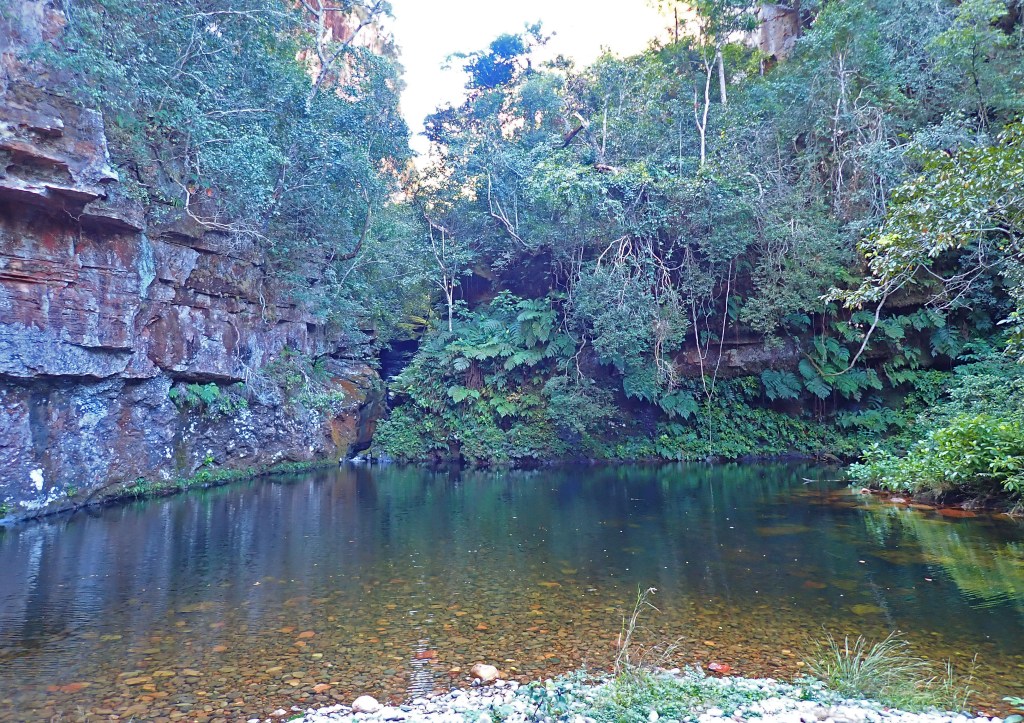
Back at the abandoned cabin, I was picking troublesome grass seeds out of my socks when Ann walked up. I had seen no spine palms, but Ann had seen many lovely ferns and a beautiful small waterfall. Somehow, we always find each other, even when separated in a previously unknown wild place. At dusk we arrived back at the plaza, exhausted after a 13 kilometer round trip.
……………………………………………………………….
From Roboré a wretchedly crowded minibus took us east toward the Brazilian frontier. After a short but uncomfortable ride we were deposited in the center of the sleepy little town of Aguas Calientes (Hot Waters). The hot springs were over a kilometer away. Our packs were heavy, and our feet worn out, so we needed a lift. It was siesta time and the taxi men were napping, so I set out on foot in search of lodging while Ann guarded our packs on a street corner.
I envisioned a cute little cabin by the river, but there were none to be had. Everyone suggested that I go to Los Hervores (The boils) where there was a public park with camping. I was dismayed to discover that it was an open field full of Mennonites on vacation. Mennonites go on vacation???
The owner of a food stall said the only place with cabins was across the river, but it was private. Aren’t all such facilities private? He pointed me toward a little bridge, beyond which was a cluster of thatched shacks.
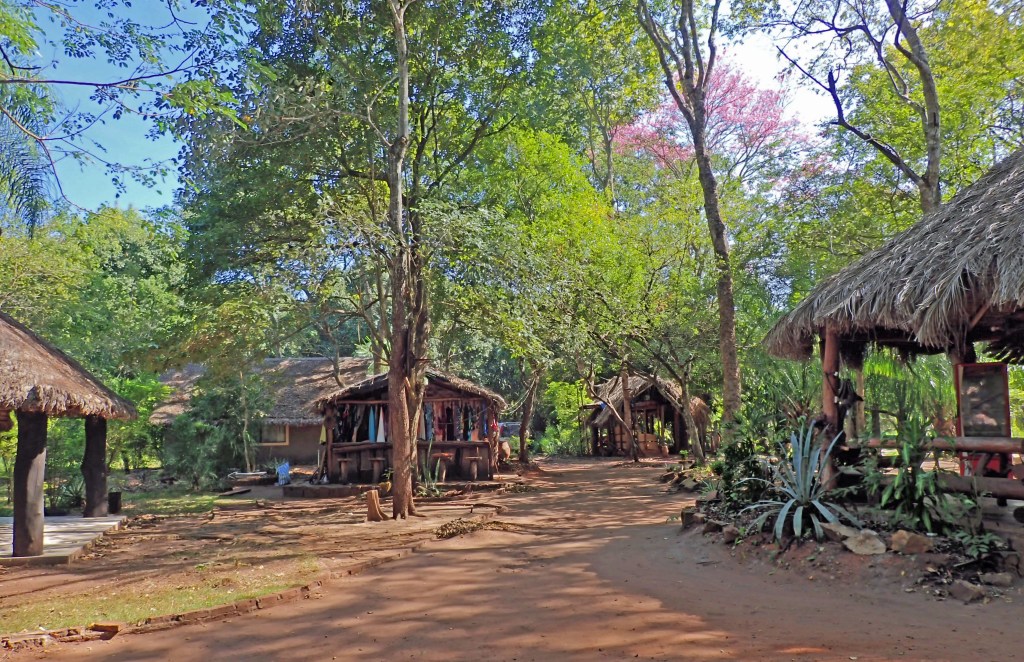
It was an odd place. The grounds were meticulously raked, yet the buildings, mostly large cabins, were in disrepair. No one seemed to be home, but eventually I found a European looking woman, a scarce commodity in this part of the world. She was an attractive middle aged hippie chick with colorful robes and flowers in her hair, the first of her sort that I had met in Bolivia. She was very talkative and explained that the cabins were intended for large families and thus cost 700 Bolivianos ($100), a fortune! I protested that there were only two of us, that we were her only customers, and that we would not pay more than 200B which was still a very high price.
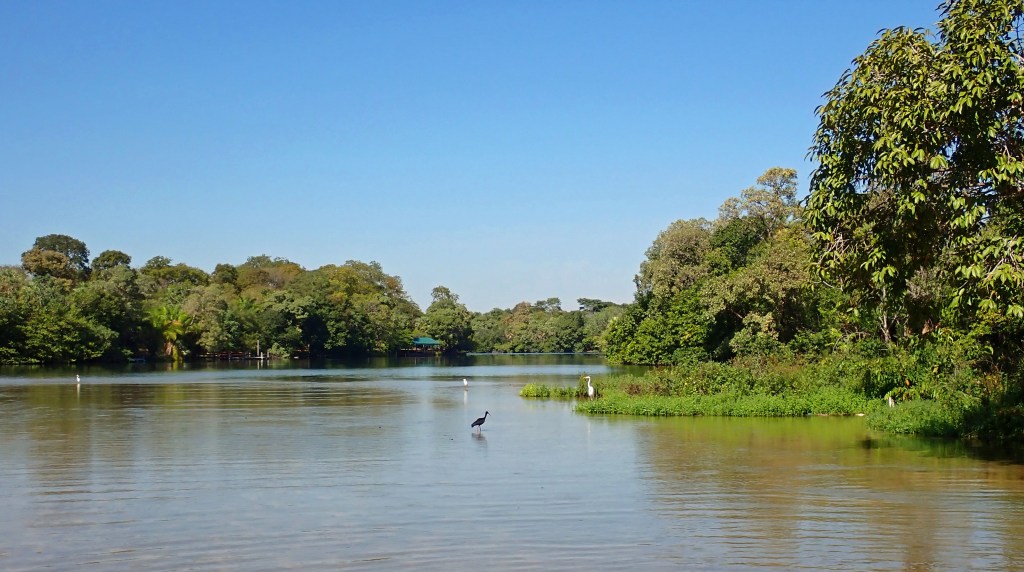
She relented, and led me to a private home where she pounded on the door until her slacker son turned off the music and emerged like a befuddled basement dweller blinking his eyes in the sun. He agreed that 200 Bolivianos was better than nothing, so he gave me my choice of the otherwise empty habitations. The price may not have been right, and the plumbing didn’t work, but the location was great! The compound was right next to the little river which exactly resembled a Florida spring run.
Marcello was clearly a hoodlum of the suburban sort who had returned home after failing elsewhere. Despite all that, he was friendly and conscientious, if not competent. He called a relative with a cab to go get poor Ann. I had been gone a long time, and she was nearly dead from standing on a street corner in the sun.
We needed supplies, especially fresh fruit, but there was no market. In all of my travels in Latin America I had never before seen a town with no market. I later learned that this was because a traveling vendor cruised the neighborhood with a loudspeaker proclaiming “Fresh fruits and veggies! Come and get um!” His fruits were indeed fresh, and he had turned the recitation of vegetable names into a sort of sung poetry. “Refréscate con mis naranjas, tomates y aguacates! La mejor para tu salud! Cómpralos ahora Señora” (Refresh yourself with my oranges, tomatoes, and avocados! The best for your health! Buy them now Ma’am!)
It was time for a dip, and we had the river all to ourselves! The water was shallow, only inches deep, and crystal clear. The water was warm, but certainly not boiling hot. The bottom was pale brown sand, perfect for wading, an altogether delightful place in which to soak one’s aching feet.
Birdlife was everywhere, especially wading birds like one might see in Florida. The trees along the river were alive with toucans, kingfishers, and numerous other species.
Scattered about were numerous sand boils (hervores) where hot water periodically emerged from beneath the sand. These jets were about 95 degrees Fahrenheit.

The sandy bottom was reasonably firm, but as we approached the boils we discovered that they emerged from quicksand! Just imagine, one moment you are walking in six inches of water, then bloop, down you go!
Just imagine, one moment you are walking in six inches of water, then bloop, down you go!
At first it was scary, but I knew from long experience that quicksand isn’t as dangerous as people think. Quicksand is simply sand suspended in upwelling water. If the bottom falls out, just lie down as though swimming and you will float back up. As it was, upon reaching the edge of a boil one would suddenly plunge waist deep, but at that point equilibrium would be reached, and like it or not you would be pushed back up. It was impossible to go any deeper.
If there is anything more soothing than lying in shallow water while being massaged by a thousand little hot jets, I can’t imagine what it might be. We found a shady boil and stayed there for hours luxuriating in paradise.
If there is anything more soothing than lying in shallow water while being massaged by a thousand little hot jets, I can’t imagine what it might be. We found a shady boil and stayed there for hours luxuriating in paradise.
After becoming thoroughly pruned we reluctantly dragged ourselves out of the boils, then waded downstream to where the water was deeper so we could take a proper swim.
Thus far we had seen no people in the river, but back at the boils Indian women were setting up stations along the bank with towels and ointments. To my astonishment fully clothed Mennonite woman were paying the Indians to cover them with mud!
There is nothing more dour than a Mennonite woman trying to have fun. They lay there silently with clenched jaws and wrinkled brows. I was very tempted to take photos, but their scowling countenances, and the menacing mien of the men who guarded them, dissuaded me. A few men stood in the water in their dungarees. It is a sin to expose one’s skin, so everyone, both wet and dry, was fully clothed.
Just to remind you what they look like, here are some pics.
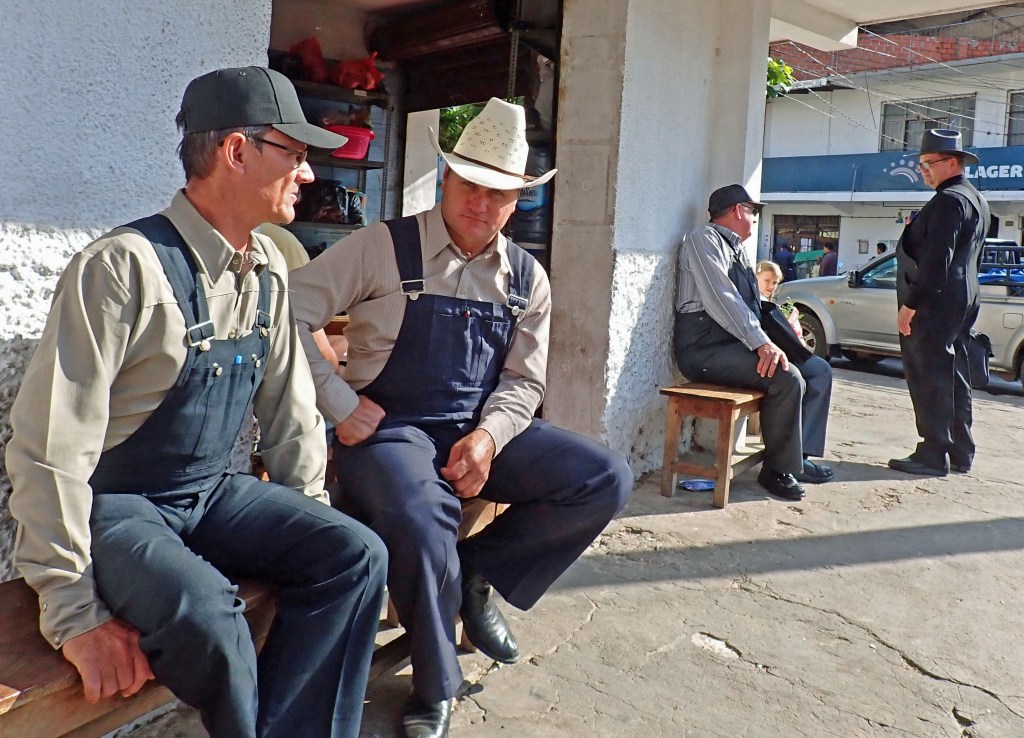

Don’t forget that these are “liberal” Mennonites, those who use mechanized vehicles with rubber tires. “Good” Mennonite women never leave the farm. The ladies above do well to remain clothed, but certain others, like the hussies below, wouldn’t look too bad in a bikini.

The only downside to bathing in quicksand is that one’s pockets and bathing suit fill with sand. The water wasn’t deep enough for me to discretely remove my suit to get the sand out; so, at the end of the day I went upstream to a deeper more secluded spot.
I noticed that two brothers had been watching me. The stern older brother stayed dry and kept guard over the women. While his attention was diverted his younger brother furtively followed me to the secluded spot. As soon as we were alone he whispered, “How much is a plane ticket to Miami?” Moments later his big brother thundered up to berate him for speaking to a stranger. I am sure he was interrogated later.
As soon as we were alone he whispered, “How much is a plane ticket to Miami?”
That evening we were entertained by the antics of the strange white Bolivian family. The owner Walter was a full fledged back to the land hippie who obsessively groomed the grounds because of imaginary tiny vipers. Some of the hot springs were bubbling up in his private swamp, so he created an elaborate series of paths and pavilions, all of which were submerging into the mud. He was convinced it was a power spot, a vortex of sorts, from which a new and better world would emerge.
Marcello, the hoodlum son, invited me to his hut to smoke a joint. With him was his dim witted half blind friend who cradled a chain saw as though it were a child while blasting horrible rap music. He jiggered and danced like a monkey on drugs with his beloved chainsaw until he would periodically notice my glasses and try to grab them. .
………………………………………………………………….
Before coming to Bolivia I had done my homework, as any good caver should, by studying geological maps. Chiquitania had outcrops of Cretaceous aged rocks with carbonate facies. It wasn’t clear to me which layers were limestone, so I pored over Google Earth to see if I could find any sinkholes.
It can be difficult to see a sinkhole in two dimensions unless one tilts the image in Google Earth. The act of tilting reveals to the brain a three dimensional aspect that is not otherwise obvious. Darker colors and changes in vegetation are also indicators.
I had already concluded that most of the Serrania Chiquitana was a sandstone plateau. But what if the sandstone was underlain by limestone? A structural failure could create a dolina (large sinkhole), and thus reveal a portal to the underworld! So I searched for dark holes.
In an uninhabited area north of Aguas Calientes I found a bowl shaped depression with dark green forest at the bottom, so I had to go.

The dusty road out of town seemed to go on forever. The landscape never varied, an ever ascending sandstone plateau covered in ruined thorn scrub.
I’ve never liked dry tropical forest, which is composed almost entirely of small trees and gnarled shrubs, because it never reaches maturity. Fire has always been a part of the landscape, but with every passing year the fires in Chiquitania have grown in frequency and intensity due to both climate change, and deliberate burning by agriculturists. The resulting vegetation is well adapted to fire, but as a consequence becomes wretched thorn scrub that rarely gets over twenty feet tall, and has none of the charm of fire adapted grassland.
There were few signs of endemism other than small columnar cacti.

The vegetation may be fire adapted, but I seriously doubt that the wildlife is. Any animal that cannot flee, or retreat underground, must surely be incinerated. I saw no signs of life other than a pile of feathers, proof that there must be predators.

There was neither soil nor rock, just sand, until I got to the stony brink of the precipice.
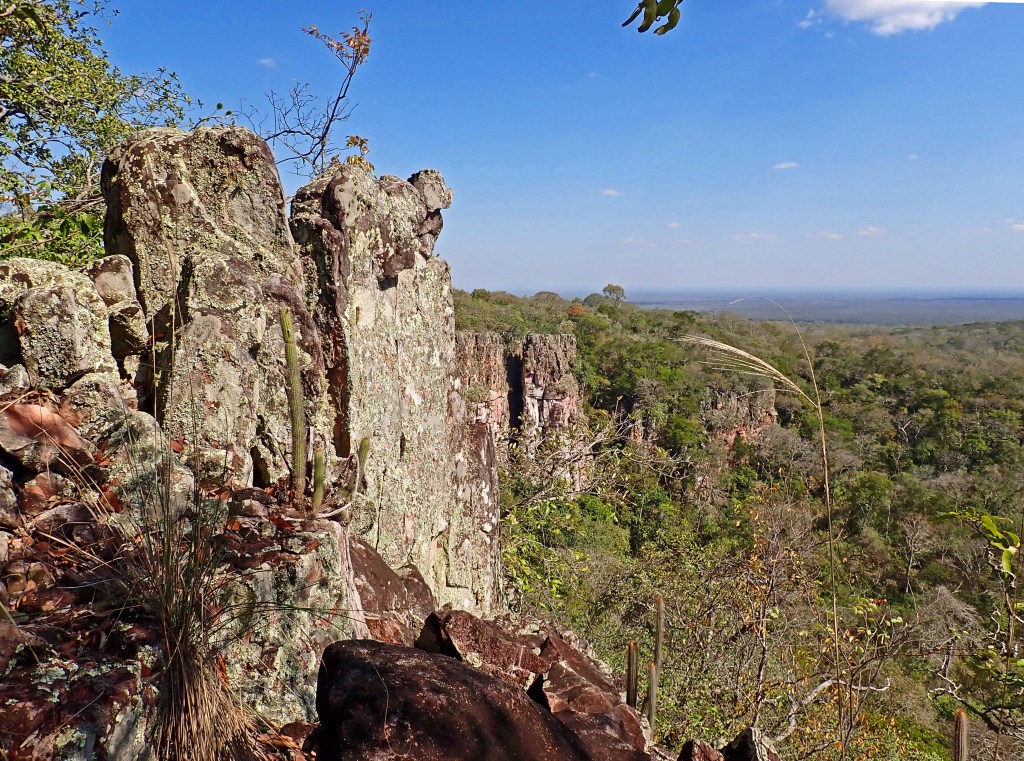
The cliff is about 150 feet high.

Perched on the edge, the ground below appeared to be a circular depression, as it does in this Google Earth image showing my track along the edge.

But is it a giant sinkhole? Is there a portal to the underworld at the bottom? In my imagination I had hoped to discover a lost world like one of the “tiankengs” in China, but that was wishful thinking. There was no sign of limestone, just sandstone. This feature is probably just the eroding edge of the plateau, and the forest darker green because of the moist sheltered conditions within the bowl.
But can’t a fellow dream? There are still unanswered questions. The limestone is still down there somewhere beneath the sandstone, but where? Are there any outcrops? The same geological formation extends into Brazil where there are known to be many caves. What of the hot springs? There must be some tectonic rift that allows the deep aquifer to reach the surface. Wherever water flows beneath the surface there is solution, and possibly caves, but the hot springs showed no signs of carbonate deposition such as the travertine dams I had seen elsewhere in Bolivia. The mystery remains, as does the inexplicable fact that Bolivia is one of the largest countries in the world with almost no known caves.
I contemplated making my way to the bottom, but it was a daunting task. I was alone in the wilderness, a worn out old man hiking in sandals. One slip and I would never be found. I reluctantly began the long trudge back, thus ending the final adventure of our time in Bolivia.
Dr. Ann had been invited to join me, but she chose to luxuriate in paradise instead. While I was gone she had been bathing in the hot springs. She ventured downstream past the mud bathing Mennonites to a secluded place where the water was waist deep. She was on her knees, and lost in thought, when suddenly a giant otter popped up directly in front of her. It seemed friendly and curious, its expressions almost human. As she gazed into its eyes it suddenly frowned (If one may say such a thing of an otter), and advanced in an angry manner toward her. She stood up, the spell was broken, and the otter disappeared.

It was good that the otter fled. Though not known to be aggressive to humans, giant otters are truly giant, and are more than capable of defending themselves. They grow to be six feet long and weigh up to 75 pounds. Their heads are almost as big as ours. They live in a world inhabited by anacondas, crocodilians, and jaguars where they defend territories and even counterattack large predators. Just imagine a weasel as big as the Weazel (That’s me!). Don’t mess with such a monster. (Either one!)
……………………………………………………………
Back in Santa Cruz at the Hostal 360 Grados, our home away from home, we were in the lobby talking to the owner Esteban about the odd people who frequented his hostel. Aside from the usual Mennonites, drug dealers, and hippies, there were Russians with whom Esteban could communicate only in broken German, and another group of rough looking men who I supposed could speak Spanish because they were so swarthy, but they spoke no language on earth comprehensible to anyone. It turned out that they were Nepalese refugees, or perhaps Dalits on the lam. They bore no resemblance whatsoever to the tame, well educated, Indians who run Patel motels here in the States. Esteban explained that all these strange people were victims of human trafficking. Imagine trying to get to the US from Nepal by way of Bolivia!
That was when I noticed a beautiful young girl of about fifteen accompanied by her younger brother. She wasn’t like the other Mennonites. Her face was all smiles, alive with emotion, and her golden hair was unrestrained. Where were her parents? Was she a victim too?
Shortly before leaving on the long journey home I snuck up to the rooftop terrace to smoke the last of my pot, and finalize my notes. Suddenly she and her brother appeared. They started kicking a soccer ball around with incredible skill. One mistake and the ball would have disappeared forever in the market below. Mennonites having fun other than by mud bathing? What is this world coming to?
She turned to me and asked in perfect American English, “Are you the scientist I’ve heard about?” Then her younger brother asked, “Is it true that you catch snakes? Do you have a car?” I was flabbergasted! I hastened to explain that I wasn’t a real scientist, just a naturalist informed by science, but yes, I do catch snakes, and I own two vehicles. Apparently I was famous! How did they know any of this, and how did they learn English?
She said, “I love science and want to learn everything!” She was interested in geology, botany, meteorology, and wanted to see the world. I was totally smitten! What kind of Mennonites were these?
We had a long and wonderful conversation in which she said they were from somewhere near Santa Cruz, not the US, but she couldn’t explain exactly where. Mennonite women in remote jungle communities rarely have any idea of where they are.
She said she spoke German at home, could barely speak Spanish, and learned English from other Mennonites. I found that hard to believe because of her fluency in idiomatic American English. It seemed that she had already learned the value of deception while living among the tyranny of bigots.
I borrowed a cell phone to show her photos of the various waterfalls I had built around the world on my website. She was astounded by the architecture, and professed to never have seen such enormous buildings, much less those with gardens inside. She burned for knowledge, and to travel the world, repeating the names of far away cities as though it was a mantra. For her entire life she had been denied information about science, and about the larger world, so perhaps her story was true?
She had a chaperone of sorts, presumably a relative. She asked for my contact information, so I was writing it down when he showed up. I assumed the worst, that there would be a terrible fight. How dare a fifteen year old Mennonite girl communicate with a dirty old man! He only shrugged. It appeared that these two brave kids were effectively homeless, just visiting an endless series of relatives, none of whom would have them because of their open minds. They had been cast out like witches.
The courage and determination of this beautiful young woman, smiling and hopeful in the face of adversity, brought me to tears. There are some people whose spirit is too strong to be crushed, and I felt honored to have met her.
So ended our trip to Bolivia in the year of our pandemic 2022.
……………………………………………………..
Stay tuned for a blast from the past as the Weazel returns to the days of his youth as we search for serpents in the Great Dismal Swamp!
 Weazelwise